Meet Florence – Science at Work

Hi Everyone,

Hope you are all okay and staying safe!

I expect you have all been going outside at 8.00 pm to clap for the NHS and all the Key workers? You have probably all heard about the Nightingale Hospitals that have opened in all the big cities. Well, we have the chance to take a step back in History and hear the life story of Florence Nightingale.

She talks about life from a young age and what made her decide on becoming a nurse.

My daughter has just qualified as a nurse and I am so proud of her. It’s a scary time, but I can’t begin to  imagine how proud all the health care workers, doctors and nurses feel right now as they do their jobs.
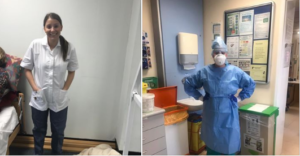
 

Here is Sian at the beginning of her training and now working as a fully qualified nurse.

This is a great opportunity for you to ask any questions to Florence Nightingale, to Sian or to the two doctors below.

Zania and Phoebe(the two doctors) will be doing an interview next week on 5th May – where they will be answering any questions you have.

Click here to download the activity sheet about Zania and Phoebe and don’t forget to send us your questions and pictures by 3 pm on Thursday 30th April. You can do this by completing the form on the Science at Work  https://pstt.org.uk/


Please keep any of the sheets that you download or questions that you write, so that I can use them for display when you are back.   This activity may get you thinking about what you would like to do when you leave school?

Caradoc English Home Learning April 28th

Yesterday I set you the task of planning and  writing a news report of Rapunzel using the WAGOLL.

Whilst you are completing this, you might like to tune into the BBC Bitesize website and take part in the activities to do with letter formation. You could join in with the caterpillar and butterfly dance!

http://https://www.bbc.co.uk/bitesize/articles/zntmxyc

Maths Home Learning Caradoc April

I would like you to practise counting  forwards and back in 10s. Try from different number, using the counting stick like we do in class e.g.

13, 23, 33, 43

89, 79, 69, 59

Try starting at 92

Now try starting at 98

Ask a grown up if they could ask you questions throughout the day e.g.


What is 10 less than…?

What is 10 more than…?

This will help to increase your fluency!

Quick recap:

e.g.

10 is………..2+7

Could you use objects from around the home to create your own statements using these symbols:

Today we are going to focus on comparing length. Watch the teaching video and try the Flashback 4:

http://https://whiterosemaths.com/homelearning/year-2/–

Now try the activities below:

Spring-Block-5-ANS4-Order-lengths-2019   

You may like to tune into the daily BBC Bitesize lesson which would be good revision on the value of different coins:

http://https://www.bbc.co.uk/bitesize/tags/z7s22sg/year-2-and-p3-lessons/1


Home Art Lesson 4

Relief Sculptures from Recyclable Materials

Hello everyone, another art lesson to express your creativity!

You’ll need to collect some junk materials for this one.

Remember to send pictures of your art to your teachers, they’d love to see them!

Picasso Pop Can Portraits: Free Lesson Plan Download | Middle ...240 Best Glorious Junk images | Crafts for kids, Junk modelling ...Big Trash Animals: Artist Turns Junk Into Animals To Remind Us ...


Caradoc challenge

Hopefully you have all seen our Holy Trinity ‘Thank You’ to key workers. I would love you to send your pictures to me so that we can create a Caradoc class thank you. 

History Topic Home Learning week starting 27th April

Have you ever visited a castle?

Have you ever read an information books about castles or read a story set in a castle?

I would like you to write at least five interesting facts about castles using what you already know, facts from a book you have read or a visit you have been on. You could use the information sheets below to help you. There are facts about castles and some information about famous castles in Great Britain, you may even have visited one!

Make sure that you write in full sentences and form your letters carefully.  

2014-tower_eng_ncr_all_about_castles 2014-tower_eng_infs_famous_castles_in_britain

Challenge:

Could you build a ‘castle’ den in your home or garden?

Mindfulness in Caradoc

Why not join in with an interactive mindfulness session with Mini the puppy in the Zen Den.

Relax, get comfortable and join in:

Staff challenge accepted!!!

We all know that the staff at Holy Trinity love having their pictures taken. They even wanted to be in on the action.

As a staff, we wanted to show our support towards the NHS and to all Key Workers – a huge thank you from all at Holy Trinity.


Science

Key Learning about plants:

The four main parts of a plant are the roots, the stem, the leaves and the flowers.


The roots anchor the plant in the ground and absorb water and minerals.

The stem holds the leaves and flowers upright, and contains helps transport water and nutrients up and down the plant.

Flowers are the plant’s reproductive parts, and the leaves are the parts where food for the plant is produced, this process is called photosynthesis.

Create a labelled drawing showing the parts of a plant, you could use pencils/crayons and paper or create a large version using chalks if you have an outdoor space. Don’t forget to send me any photographs!


Acts of Kindness

Connie and George planned a day of kindness, hoping to bring a smile to someone’s day. They planned to buy flowers for 5 key workers, thought about how it might make them feel then worked out the cost! They chose to buy flowers for a nurse, a hospital worker, two carers and a shop worker.

How lovely- well done George and Connie!