If you are concerned about a child, young person or a member of staff, please ask to speak to a member of the School’s Safeguarding Team.
“The school may share information regarding your family circumstances with the Local Authority Children’s Services if there are safeguarding concerns or with the Early Help Service if there are issues which may affect your child’s welfare or happiness.”
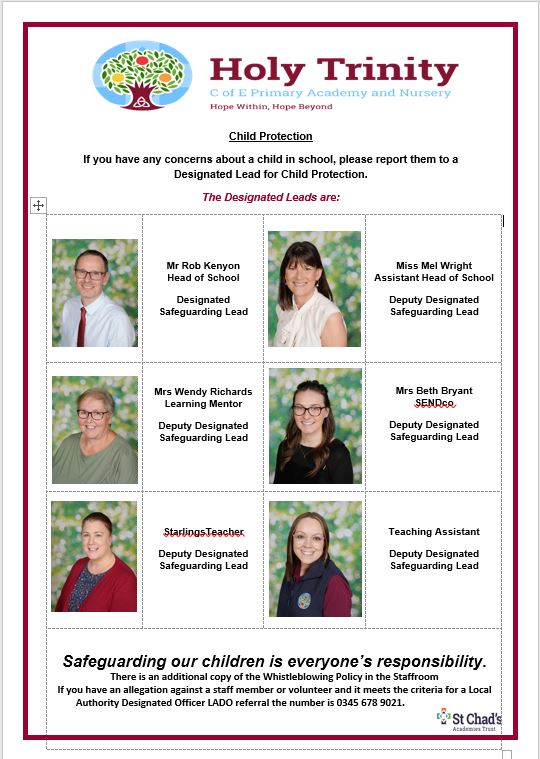
Designated Safeguarding Lead: Mr R Kenyon
Deputy Designated Safeguarding Leads:
Please click the links below to read our Safeguarding policies:
Safeguarding and child protection policy
https://www.gov.uk/government/publications/keeping-children-safe-in-education–2
https://www.westmercia.police.uk/advice/advice-and-information/cl/county-lines/core-info-emotional-neglect-5-14 (1)
What is CPOMS?
CPOMS is the market leading software application for monitoring child protection, safeguarding and a whole range of pastoral and welfare issues. Working alongside a school’s existing safeguarding processes, CPOMS is an intuitive system to help with the  management and recording of child protection, behavioural issues, bullying, special educational needs, domestic issues and much much more. Using CPOMS, schools can ensure that students are safe and fully supported, whilst school staff can focus on teaching and providing support, instead of administration.
Every member of staff across school has an obligation to report any concerns which they may have. CPOMS allows them to record information in a central repository and have relevant people alerted immediately. Senior leaders are able to build a chronology around a student and can produce reports on vulnerable pupil groups for Case Conference Meetings, Governors and Ofsted at the touch of a button.
Equality Duty Statements
The Public Sector Equality Duty requires our school to monitor our policies and procedures and to publish information about equalities in our school. The Equality Act 2010 has 3 main ‘General Duties’ which we must aim to achieve, these are:
- To eliminate unlawful discrimination, harassment and victimisation and other conduct prohibited by the Act.
- To advance equality of opportunity between people.
- To foster good relations between people who share a protected characteristic and those who do not.
The Equality Act 2010 states that it is unlawful to discriminate against people with the following protected characteristics. This applies to the whole school community:
- Age
- Disability
- Gender
- Gender reassignment
- Pregnancy and maternity
- Race (ethnicity)
- Religion and belief
- Sexual Orientation
We believe that equality at our school should permeate all aspects of school life and that it is the responsibility of every member of the school and wider community. Everyone within our school community should feel safe and secure, they should feel valued and of equal worth, these include:
- Children and young people
- All staff employed at the school
- Students on placement
- Parents/carers
- Governors
- Agency staff
- Contractors working at our school
- External agencies whose staff are working with our school, including Health, Social Care, Special Needs support and agencies such as the Department for Education, Ofsted and School Improvement Partners
- All visitors to the school
The ‘Specific Duty’ for schools is to gather and publish information to show how we are complying with the Equalities Duty; how we remove or minimise disadvantage and take steps to meet different needs and encourage participating when it is proportionately low. We record and analyse the progress and attainment of all children, including vulnerable groups. NB Due to small organisational numbers which would allow for specific people to be identified groups are combined or not published.

Operation Encompass is a partnership between police and schools, a school can only join if the local police force has already joined Operation Encompass.

One of the principles of Operation Encompass is that all incidents of domestic abuse are shared with schools, not just those where an offence can be identified.
Operation Encompass is very simple and easy to implement within a school.
West Midlands Safeguarding Children Group (procedures.org.uk)
Click the link to see the NSPCC Speak Out, Stay Safe Assembly featuring Any & Dec – https://youtu.be/qm0kccbZpYY
Childline is a free 24-hour counselling service for children and young people up to their 19th birthday in the United Kingdom provided by the NSPCC. Childline deals with any issue which causes distress or concern, common issues dealt with include child abuse, bullying, mental illness parental separation or divorce, pregnancy, substance misuse, neglect and psychological abuse.
Childline is yours – a free, private and confidential service where you can be you. Whatever your worry, whenever you need help, however you want to get in touch. They are there for you online, on the phone, anytime.
A childline counsellor:
- Will listen to you
- Knows it takes courage to contact us
- Is genuine, open and friendly
- Knows about the problems young people can face
- Wont judge you or put you down
- Isnt easily shocked
- Will let you take your time
6 Facts about Childline:
- They were started in1986 by Esther Rantzen
- They help any young person in the UK
- You can talk to them in English or Welsh
- They can help with anything – from abuse and bullying to exam stress and relationships
- Calling Childline is free and doesnt show up on the phone bill
- In 2006 they joined the NSPCC to help even more young people
CONTACTING CHILDLINE
You can talk to them about anything. No problem is too big or too small.
Call them on 0800 1111 or get in touch online. However you choose to contact them, you’re in control. It’s confidential and you don’t have to give your name if you don’t want to.
Attendance
Dear parents/carers,
RE: Attendance Reminder
We believe that we do amazing and important things every day in school and that every day and every minute matters – that’s why we work to ensure that every child has good attendance. We hope you can help us with this goal.
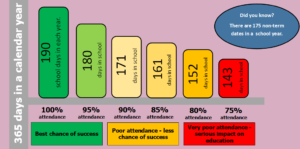
Children’s attendance at school is very important so they do not miss out on valuable learning as well as developing relationships with their peers. We closely monitor attendance across the year and we expect it to remain above 95%. Anyone with attendance below 90% is classed as a persistent absentee. As per local authority guidance we are unable to grant children with attendance below 90% authorised time out of school and therefore any child who has attendance below 90% will not have their absence authorised by school without medical evidence or proof of exceptional circumstances.
We work hard to support children and families who are experiencing problems with attending school. If you would like someone to talk to about attendance or need some additional help and advice around your own child’s attendance please contact Mrs. Richards on 01691654832.
Children whose attendance goes into the Amber at risk zone (below 95%) or the Red danger zone (below 90%) will have their attendance monitored on a weekly basis and from Monday 20th October 2023 parents of children who have attendance in these zones will receive weekly messages via our app/text message to keep you up to date with your child’s attendance.
I am me!
i am ME! is a project designed to help communities, statutory agencies and any workplace setting, recognise and understand the impact of hate crime.
Hate crime is the term used to describe an incident or crime against someone based on a part of their identity. It can take the form of any criminal or non-criminal act such as graffiti, vandalism to a property, name calling, harassment, assault or online abuse using social media.
We will support you whether you have reported the crime or not. We understand that some people may not want to report hate crime to the police and that’s fine. However, if you did want to report you can do so in the following ways:
■ Direct reporting to the police (101 or 999 in emergencies).
■ Using a third party reporting centre – reporting to a third party organisation who will communicate with the police and other agencies on your behalf. Victim Support is a third party reporting centre.
■ Anonymous reporting on the internet via True Vision www.report-it.org.uk. Victim Support can also support you with this.
P2811 i am Me! leaflet_v3
County Lines
County Lines exploitation is the process by which drug networks or gangs groom and exploit children and young people to carry drugs and money from urban areas to suburban and rural areas, market and seaside towns, using dedicated mobile phone lines or other form of “deal line”. They will often use coercion, intimidation, violence (including sexual violence) and weapons. County lines activity and the associated violence, drug dealing and exploitation has a devastating impact on young people, vulnerable adults and local communities.
The County Lines process is now understood as a driving causal factor in youth violence and, in some cases, includes elements child trafficking. An updated report by the National Crime Agency (NCA) has found that the use of ‘county lines’ by gangs, is a growing issue, and is exploiting ever-younger victims.
Signs of County Lines or other forms of Criminal Exploitation
- Returning home late, staying out all night or going missing
- Being found in areas away from home
- Increasing drug use, or being found to have large amounts of drugs on them
- Being secretive about who they are talking to and where they are going
- Unexplained absences from school, college, training or work
- Unexplained money, phone(s), clothes or jewellery
- Having a second, old phone (i.e. not a smart phone)
- Increasingly disruptive or aggressive behaviour
- Using sexual, drug-related or violent language you wouldn’t expect them to know
- Coming home with injuries or looking particularly dishevelled
- Having hotel cards or keys to unknown places.
What to do if you suspect a child is involved in County Lines or other gang activity
Parents/carers should report your concerns to one of the Safeguarding Leads:
- Mr Kenyon
- Mrs Richards
- Miss Wright
- Miss Bryant
- Mrs Dorofte
Alternatively, you can report your concerns directly to the Police or the MASH team.
Members of the public should report County Lines, or other related concerns, directly to the police or the MASH team. https://www.nationalcrimeagency.gov.uk/what-we-do/crime-threats/drug-trafficking/county-lines
_County_Lines__preventing_vulnxploitation_A4_editable_poster1
PREVENT
As part of our ongoing safeguarding and child protection duties we are fully behind the government’s Prevent Strategy. At the end of March 2015, the Counter Terrorism and Security Act received Royal Assent. The Act includes a new duty to Prevent people from being drawn into terrorism. This duty applies to a range of organisations, including schools. Extremism and radicalisation are just another part of our school’s safeguarding duties. From 1 July 2015 all schools are subject to a duty under section 26 of the Counter-Terrorism and Security Act 2015, in the exercise of their functions, to have “due regard to the need to prevent people from being drawn into terrorism”. This duty is known as the Prevent Duty for Schools. What is the Prevent Duty? There are four key duties for schools: Identify local risks, identify at risk students, work in partnership with other agencies and to keep children safe online, where much of the radicalisation takes place. The Prevent duty applies to all schools, whether state-funded or independent, as well as early years providers and children’s homes.
Guide for parents – Prevent Guide
What are my school’s responsibilities under the Prevent duty? – Educate Against Hate
OUR CONFIDENTIALITY PROMISE
Confidentiality means not telling anyone else about what you’ve said. So whatever you say will be just between you and Childline and you can feel safe talking to them, knowing that no one else will find out. But sometimes, if they are worried about your safety, they may need to get you help.
Digital Lives
Social Media and Mental Health
TikTok
Roblox
Are you worried about online sexual abuse or the way someone has been communicating with you online?
Make a report to one of CEOP’s Child Protection Advisors
Visitors Handbook (2) (2)
Welcome to Holy Trinity CE Primary Academy & Nursery. We hope you will enjoy your time at our school. Our main priority is to ensure that everyone who visits is aware of their responsibilities towards making sure all young people are safe.
If you are visiting the school, you will be required to show some ID to reception staff if you are not known to them as part of our Safeguarding/Child Protection policy. Please have this ready when you arrive.
Visitors and contractors will be given a badge that they should wear and display at all times when on the school premises.
Be Safe
- Please ensure you are aware of the school’s Safeguarding Procedures including safer working practices, confidentiality and emergency procedures.
- Before helping in school, all adults working in regulated activity will have undertaken a DBS check appropriate to their role and will be asked to agree their acceptance of school policies at induction.
- Volunteers/adults are reminded that they may not support/help a child in isolation as a matter of safety for all. You must not have any physical contact with any student.
- You must never exchange personal contact details with a student or arrange to meet them outside of the school environment.
- The member of staff you are working with will be responsible for sharing other procedures and additional information specific to the context in which you will work.
- All matters relating to school should remain confidential.
- All contractors should check the school’s asbestos plan and sign to say they have been provided with all recorded information on the location and condition of ACMs.
Emergencies
- If you hear the continuous sound of the fire alarm, please leave the building immediately by the nearest exit and assemble in the ball courts. Do not re-enter unless you are told to do so by the Trust Headteacher/Assistant Headteacher.
- Please familiarise yourself with the nearest fire exits and ensure that any furniture or equipment used does not obscure them.
- In the unlikely event of an accident to an adult or child, please inform a member of staff immediately. Some staff are first aid trained and all accidents or ‘near misses’ must be reported. You may be asked to complete an accident report form and we would appreciate your co-operation in doing so.
- If you see or hear something that concerns you, then please speak to a senior member of staff.
- Any safeguarding or child protection concerns should be immediately reported to a member of staff at the school office who will locate the DSL.
The fire alarm is tested weekly on Thursday at 8:45am.
Parking at the School
Visitors can use the academy car park which can be used if a space is available and would not obstruct staff members leaving school. There is alternative parking by the old “Sure Start building” and surrounding roads. Please ensure you adhere to road signage and do not create an obstruction or danger to others.
Mobile Devices:
- The use of personal mobile phones is not permitted during the school day.
- Images must not be taken of any child or adult without the prior approval of a staff member and only then on a school device.
Data Storage Devices:
The use of data sticks, CDs etc. is not permitted. Visitors may use their own laptops with our projectors/e-screens by prior arrangement.
PLEASE REMEMBER
All adults in school are expected to be an excellent role model to the children at all times.
We are committed to safeguarding and promoting the welfare of children and young people and expect all staff, volunteers, visitors and outside agencies to share this commitment.