Maths Home Learning 5th June

Good morning!

Today we are going to finish learning about position and direction. As a quick recap of what you have already learnt, join in with Hip Hop Granny’s position and direction rap!

Click on the link below:

http://www.bbc.co.uk/sport/av/supermovers/42626760

Here are the words in case you want to join in!


Super_Movers_PositionandDirection_Key_Stage_1_Lyric_Sheet

There is an animated video below to remind you about the language we use to describe position and direction:

Click the link here:

http://www.bbc.co.uk/bitesize/topics/z2grd2p/articles/zwv6b82


Finally to complete our unit how about a bit of ‘Where’s Wally Fun’?You need to help Wally find the items he has lost by using the language of position and direction to give instructions and move him.

The game sheet is here but don’t worry if you can’t print- you could draw your own in your work book or even take some chalk if you have an outside space and draw it there.

I would love to see some photographs of your work!

Maths Home Learning 9th June

Good morning!

Practise the days of the week by joining in with the ‘Days of the week’ rap!

Today we will focus on measuring mass in grams (g).

The teddy weighs 20g. The weights are 5g each ( 5 + 5 + 5 + 5 =20g) and the scales are balanced.
Can you say how many grams these objects weigh?
You may have seen scales like this in your kitchen at home or in the cookery room at school. You need to read the scale. Can you see the mass of the cookie in grams is 20g. What is the mass of the toy in grams?
The scales are marked in intervals of 10.

Reasoning Cheeky Challenge:

Use the stem sentence: The……bean bag is heavier. I know this because………

Now for the fun bit! If you are able to, practise using scales to measure grams and make some delicious biscuits!

Here is the recipe:

Ingredients

  • 250g butter softened
  • 140g caster sugar
  • 1 egg yolk
  • 2 tsp vanilla extract
  • 300g plain flour

Method:

  1. Mix 250g softened butter and 140g caster sugar in a large bowl with a wooden spoon, then add 1 egg yolk and 2 tsp vanilla extract and briefly beat to combine.
  2. Sift over 300g plain flour and stir until the mixture is well combined – you might need to get your hands in at the end to give everything a really good mix and press the dough together.
  3. Roll out the dough and cut using a cookie cutter.

4.Bake for 15 minutes at 180 degrees.

I would love to see some photographs!

Maths Home Learning 12th June

Good morning!

Join in with this fun song to warm up your brain and recap recording tally charts:


We are going to move onto capacity and volume. Let’s start by looking at this picture, can you label the bottles using the word bank?


t-n-2545119-how-much-does-it-hold-activity-sheet

We measure capacity in Litres (l) and Millilitres (ml).

There are 1000 ml in one l.

How many containers can you find in your home that you could use to measure capacity?

Reasoning Cheeky Challenge:

English Home Learning 4th June


Good morning!

I hope that you have been practising your spellings and your letter formation.

I would like you to plan a story based on the Bubbles animation you have bee watching, you can watch it again below:


I have added a story mountain plan template which you may like to use to plan your story or you could create your own. You could print this or draw your own in your workbook.

Think carefully about the setting for the story, how could you describe it?

Story mountain plan -middle ability

You could use Story maker to record your story, I have set it as a 2do on Purple Mash.


Maths Home Learning 4th June

Good morning!

Warm up by practising counting in 10s. Think about our counting stick:


You could use the 100 square if you need to:


Ask someone at home to challenge  you by asking questions like:

What is 10 more  than 45

What is 10 less than 32

or if you are feeling really confident-

What is 20 more than 67


Cheeky Challenge:


Topic Home Learning week 1 Summer term

Our new topic is all about beaches and coastlines.

Have you ever been to the seaside? Who did you go with? What did you do there?

The United Kingdom  where we live is made up of many islands and  has a vast and expansive coastline. Have a look at the map and read the the names and locations of the bodies of water that surround the UK.

You can print this map here:

2020-coast_eng_map_united_kingdom

2020-coast_eng_rsh_united_kingdom

See if you can label this map of the UK, there is a printable sheet but if you can’t you could learn the names. Ask someone you live with to test you!

Maths Home Learning 3rd June

Good morning!

Practise your number bonds, you could play ‘Hit the Button’ :

https://www.topmarks.co.uk/maths-games/hit-the-button

Try to 10 first then challenge yourself to 20 or to 100. How quick are you?

Cheeky Challenge:


English Home Learning 3rd June

Good morning!

I hope that you have been practising your letter formation as you practise  this weeks spellings. Don’t forget to practise words from the common exception word list sent home ( it is also under the spelling tab). This fun video might help you to learn to spell some of these words:

You could ask someone who lives with you to say a sentence with one of these words in for you to practise writing.

Did you enjoy the ‘Bubbles’ video yesterday? I hope that you checked your punctuation as you wrote your questions. 

Watch the video again, try to imagine that you are walking along the beach – what sort of things might you find. Make some notes in your workbook.


I would like you to write a list of the things you might find. Remember to put a comma between each item except for the last item where you write and.

Here is my list of things I would like for my lunch:


I would like ham sandwiches, strawberry yogurt, a juicy apple and drink of orange juice.

Finally, have a look at Deni’s ‘Bubble’ work from yesterday:


Science Home Learning week starting 1st June

Flowering plants
Like all living things, plants need to
reproduce, or make more of themselves.
Some plants, called flowering plants,
have a special way of reproducing.
When the plant has enough energy, and
the time of year is right, it creates a
flower.
They need to move material called pollen
from one flower to another. However, they
need the help of other living things.
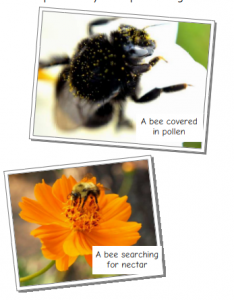
The flower is excellent at attracting flying
insects, such as bees. It contains nectar,
which is a sugary liquid which animals can
use as food. The flower is often brightly
coloured and has a strong scent, which
makes it better at attracting insects.
When the insect enters the flower, some
pollen might stick to it. When the insect
flies to another flower, the pollen might
fall off into the flower. When pollen from
one flower goes into another flower, the
flower is pollinated.
Once a flower has been pollinated, it has
enough material to produce a seed. The
seed is capable of growing into another
plant.
Plants have different ways of moving
their seeds to good growing spots – some
use the wind, some use animals, and some
use totally different ways!


Activity
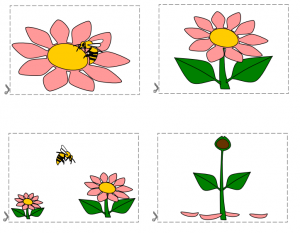
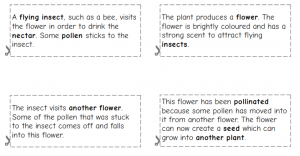
Below, you will find some
pictures and some descriptions.If you are able to print, carefully,
cut them out, match the descriptions to
the pictures and place them on the
diagram in the correct place. Otherwise you could draw the pictures and write the matching description.
 

Discussion
What would happen to flowering plants if
the pollinating insects disappeared?

English Home Learning 2nd June

Good morning!

I hope that you have been practising your new spellings and letter formation. There is a spelling activity set on Purple Mash which you may enjoy.

Look carefully at this picture. What does it make you think about?

Make a list of questions about this picture. Remember to start each question sentence with a capital letter and end with a question mark.

You will need to use question words, this poster might help:

This is my question:

Where did you get your bubble pot from?

Why not ask someone in your family what questions they would ask. Remind them about question punctuation.

Now watch the video below:


Do you have any more questions?

Did you manage to answer any of your questions?

Write your questions out in your best handwriting.


CEOP
Parent View - Give Ofsted your view on your child's school
© Holy Trinity CE Primary Academy and Nursery 2026
Shropshire web design by kiskadoo