Africa Day – Half Term activities

Monday 25th May is ‘Africa Day’, it’s also Half Term. As you know teachers won’t be posting daily over Half Term -it’s time to spend time with your family and be together. We are also posting a range of activities for you to do together.

AFRICA DAY  – below are a range of activities covering the topic Africa.

africa-challenges

africa-habitat-drawing-ks1

african-music-activity

african-poetry

african-yoga-cards

africa-tangram-ks1

Africa-tribal-mask-colouring

africa-wellbeing-colouring

africa-wellbeing-ks1

challenge-max-africa-edition

crafting-activity-2

junglemeasuring

learn-to-speak-swahili-poster

rumblecounting20

rumblesubtract20

Africa Day – Half Term Activities

Monday 25th May is ‘Africa Day’, it’s also Half Term. As you know teachers won’t be posting daily over Half Term -it’s time to spend time with your family and be together. We are also posting a range of activities for you to do together.

AFRICA DAY  – below are a range of activities covering the topic Africa.

EYFS

africa-challenges

African-animal-drawing-eyfs

african-music-activity

african-yoga-cards

africa-tangram-eyfs

Africa-tribal-mask-colouring

africa-wellbeing-colouring

africa-wellbeing-eyfs

challenge-max-africa-edition

crafting-activity-3

handaplaydough

learn-to-speak-swahili-poster

rumblecounting10

KS1

africa-challenges

africa-habitat-drawing-ks1

african-music-activity

african-poetry

african-yoga-cards

africa-tangram-ks1

Africa-tribal-mask-colouring

africa-wellbeing-colouring

africa-wellbeing-ks1

challenge-max-africa-edition

crafting-activity-2

junglemeasuring

learn-to-speak-swahili-poster

rumblecounting20

rumblesubtract20

Africa Day – Half Term activities

Monday 25th May is ‘Africa Day’, it’s also Half Term. As you know teachers won’t be posting daily over Half Term -it’s time to spend time with your family and be together. We are also posting a range of activities for you to do together.

AFRICA DAY  – below are a range of activities covering the topic Africa.

africa-challenges

African-animal-drawing-eyfs

african-music-activity

african-yoga-cards

africa-tangram-eyfs

Africa-tribal-mask-colouring

africa-wellbeing-colouring

africa-wellbeing-eyfs

challenge-max-africa-edition

crafting-activity-3

handaplaydough

learn-to-speak-swahili-poster

rumblecounting10


Africa Day – Half Term activities

Monday 25th May is ‘Africa Day’, it’s also Half Term. As you know teachers won’t be posting daily over Half Term -it’s time to spend time with your family and be together. We are also posting a range of activities for you to do together.

AFRICA DAY  – below are a range of activities covering the topic Africa.

africa-challenges

African-habitat-drawing-LKS2

african-music-activity

african-poetry

african-yoga-cards

africa-tangram-ks2

Africa-tribal-mask-colouring

africa-wellbeing-colouring-ks1andks2

africa-wellbeing-ks2

challenge-max-africa-edition

crafting-activity-2

jungleweighing

learn-to-speak-swahili-poster

tp-f-2889-african-animal-top-trumps-card-game-648484

Fun Friday! YAY!!

Today’s ‘Fun Friday’ is inspired by Larna. I was really impressed with her beautiful art work, I thought we all could have a go.

What  you need:

Masking tape,

paper, card or a canvas,

paints and paint brushes.


Step1: Stick masking tape onto the material you are using to paint. Stick them in different  directions, to create lines. They can be straight, diagonal, vertical or horizontal.

Step 2: Paint the paper that is on show. Paint them different colours so no two colours are near each other. You could  even add glitter to a section.


Step 3: When the paint is dry,slowly peel of the masking tape. Then to finish off your art work you could go around the white with a fine black pen.

CHEEKY CHALLENGE: You could create a zig-zag lines an other shapes. See below.


I would love to see all your art work Please send them to:hawkstone@holytrinitycepa.co.uk

Classic film Number 5

Classic film number 5 – The Never Ending Story 1984 – PG.  Available on Netflix or if you have it on DVD.

Synopsis – On his way to school, Bastian (Barret Oliver) ducks into a bookstore to avoid bullies. Sneaking away with a book called “The Neverending Story,” Bastian begins reading it in the school attic. The novel is about Fantasia, a fantasy land threatened by “The Nothing,” a darkness that destroys everything it touches. The kingdom needs the help of a human child to survive. When Bastian reads a description of himself in the book, he begins to wonder if Fantasia is real and needs him to survive.

Once you have watched the film see if you can make the ‘Luck Dragon’ from cotton wool, towels or blankets –  See images below


SPAG – Apostrophe for omission (contraction)

You can use apostrophes to show that you have omitted (left out) some letters when you are joining words together.

For example, you can join the words ‘you’ and ‘are’ together. You + are = you’re. The apostrophe takes the place of the removed letters. In this example, the letter a.

Sometimes, however, you need to rearrange the letters a bit when you contract the words. For example: will + not = won’t.

Using contractions like these makes your writing easier to read and more friendly.

https://www.bbc.co.uk/bitesize/topics/zvwwxnb/articles/zcyv4qt

I am attaching a skills sheet and a matching game.
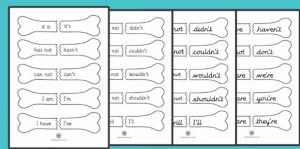
Punctuation—Apostrophes-for-omission

Contaction Match Game – year 2, 3, 4, 5, 6, punctuation, spellings


Below are a number of games which you can play all about apostrophes for omission / contraction.

https://www.learninggamesforkids.com/vocabulary-games/contractions/where-does-the-apostrophe-go.html

https://www.learninggamesforkids.com/vocabulary-games/contractions/pick-the-correct-contraction.html

https://www.learninggamesforkids.com/vocabulary-games/contractions/contraction-memory-match.html


Year 5 English and Maths

English – Learn how to write a letter.

https://www.bbc.co.uk/bitesize/articles/z6hvgwx

When writing a formal letter there’s a few key things to remember. The list below will help you get started!

Key features of a formal thank you letter

Layout – including address and date

  • Your address should be written in the top-right corner of the page.
  • The date should be written below your address.
  • Below the date on the left hand side of the page, write the recipients address.
  1. Who are you writing to?
  • If you do know the person; use their name, eg Dear Ms M Coles.
  • If you don’t know the person/people then use Dear Sir/Madam.
  • Remember, add a comma after their name.
  1. Beginning the letter

Your opening sentence should get to the point and clearly state why you are writing:

  • I am writing to say thank you for …
  • I write to share my gratitude for…
  1. Tone (the way the letter sounds)
  • The aim is to sound businesslike whilst also being warm and friendly.
  • Avoid using too much language that seems casual or chatty.
  1. Paragraphs
  • Include all the relevant details of why you are thankful.
  • Make sure that each point you make has a separate paragraph.
  1. Closing statement
  • Restate the main point of your letter.
  • Make sure that you provide an action for the reader, eg keep smiling and take care.
  1. Ending your letter
  • Use yours sincerely if you do know the person.

  • Use yours faithfully if you don’t know the person.

Top tip!

Remember, checking your work and redrafting is part of the writing process. Don’t be afraid to make mistakes!

Super challenge

Think back to the other lessons from this week. In your letter, try to include:

  • similes and metaphors

  • modal verbs

  • adjectives

  • clear paragraphs

Maths – Learn all about subtracting two mixed numbers.

https://www.bbc.co.uk/bitesize/articles/zhs9d6f

When subtracting mixed numbers, you can use a similar method to subtracting two fractions, but you have an added step of subtracting integers.

Here are two main methods that you can use.

Method 1

This method allows you to break down (partition) the mixed numbers into fractions and whole numbers so that you can subtract them separately.

5 ²/₃ – 2 ²/₉

Step 1: Partition the mixed numbers so you are left with the whole numbers together and the fractions together.

²/₃ – ²/₉ =

5 – 2 = 3

You can quickly subtract the whole numbers to make 3.

Step 2: Focus on the fractions now. They have different denominators so you need to change one into its equivalent fraction, so they have the same denominator.

You can’t simplify ²/₉any further so you have to change ²/₃

Multiply the numerator and denominator by 3.

Step 3: Subtract the numerators now.

⁶/₉ – ²/₉ = ⁴/₉

Step 4: Now you have to add the two answers from the whole numbers and fractions together so that they become a mixed number again.

3 + ⁴/₉ = 3 ⁴/₉

Here’s a checklist to remind you of the steps for this method:

  • Partition and subtract whole numbers
  • Check and change denominators
  • Subtract the numerators
  • Whole numbers answer + fractions answer = final answer!

Method 2

This method requires you to change the mixed numbers into improper fractions.

Remember, an improper fraction is a fraction where the numerator is greater than the denominator like ⁹/₅

2 ¹⁄₅ – 1 ⁵/₂₅

Step 1: Change the fractions so that they have the same denominator.

Divide the numerator and denominator by 5.

Step 2: Convert the mixed numbers into improper fractions.

2 ¹⁄₅ – 1 ¹⁄₅ =

¹¹⁄₅ – ⁶/₅ =

Reminder:

  • Multiply the integer (whole number) by the denominator.
  • Add that to the numerator.
  • Write the answer on top of the original denominator.

Step 3: Subtract the numerators.

⁵/₅ is one whole so can be written as 1.

Another example of when Method 2 might prove useful is this sum:

3 ¹⁄₉ – 1 ⁴⁄₉

⁴⁄₉ is larger than ¹⁄₉ therefore we can’t partition in the same way as Method 1 and it is harder to solve mentally as involves exchange.

As the denominators are the same we can move straight to Step 2 and convert the mixed numbers into improper fractions.

3 ¹⁄₉ = ²⁸/₉
1 ⁴⁄₉ = ¹³/₉

Step 3: Subtract the numerators.

²⁸/₉ – ¹³/₉ = ¹⁵/₉ = 1 ⁶/₉

Here’s a checklist to remind you of the steps for this method while you work:

  • Check and change denominators
  • Convert to improper fractions.
  • Subtract the numerators.
  • If needed, convert answer back to a mixed number.


Year 4 English and Maths

English – To write a formal report about badgers.

https://www.bbc.co.uk/bitesize/articles/zrb48xs

Reports are informative pieces of writing that give information to the reader about a certain topic. For example: space, the bald eagle, Scotland, flags of the world or anything else you’re interested in.


Report rules

  • All the information must be about the same topic.

  • You should provide the audience with lots of facts and evidence rather than personal opinions.

  • Reports must be set out clearly with a title, introduction, paragraphs, subheadings and images. (Subheadings are little titles for each paragraph, or group of paragraphs, to explain what they are about.)

  • They should be written in a formal tone (like how you would speak to your head teacher).

  • They should be written in the present tense (as if the actions are happening now).


Maths – Learn how to compare fractions, including fractions that are greater than one whole.

https://www.bbc.co.uk/bitesize/articles/zbdj7nb

You can compare fractions in many different ways.

You could compare fractions by the numerator or by the denominator, or compare them to common fractions you know such as ½.

Bar models are a very useful visual representation to help you to generalise.

three quarters and a half

Classic film number 4

Classic film number 4

If you have Netflix or have the film on DVD,  you can watch the next film –  Hook 1991 – U.

Synopsis – Peter Pan, the boy who wasn’t supposed to grow up, did just that. But vengeful Capt. Hook kidnaps Peter’s kids, forcing him to return to Neverland.

I have added a number of creative crafts to go along side the  film. Can you think of any of your own.

CEOP
Parent View - Give Ofsted your view on your child's school
© Holy Trinity CE Primary Academy and Nursery 2026
Shropshire web design by kiskadoo