Home Learning – Tuesday 16th June

Good Morning!

Was there a huge storm where you live last night?! There was amazing thunder and lightening where I live! There were forks in the sky and all of our power went out! It was very exciting and a little bit scary!

English

This week we are going to be looking at instructions. We have done instructions before so we should be really good at them by now! Today’s activity is a really fun one! I would like you to follow my instructions to make your very own Woodland Crown!
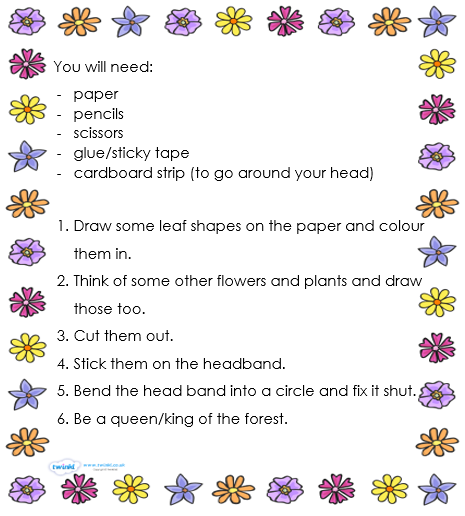
Before you start, I would like you to find all the different features of a set of instructions. See if you can remember them first. If not here is a list to help you:

  • equipment
  • numbers
  • Bossy verbs

My instructions aren’t very specific. As you make the crown, think about what information I could include to make my instructions better. Could I include colours? Have I told you when to use the equipment? Have a good think about how to make the instructions amazing. Is there a way of making this actual crown even better? Could you add something? (We will be writing our own instructions and making even better crowns later in the week – so let the children tell you that this one isn’t very good!)

Adults: please take a photo of your child at each step. This will help as a prompt for when they write their own instructions. 


Maths:

Year 1: https://www.bbc.co.uk/bitesize/articles/zqps2v4

Reception:

Today I would like you to do some singing! You can use your fingers to help. I would like you to sing some songs that involve counting backwards! Here are some ideas:


Try and focus on the idea that each time you are taking one away! As a cheeky challenge, you can have a go at writing some of the number sentences! 

Hope you have an amazing day!

Incredibox!

Good morning!

We’re going to get muscial in this session.

Incredibox is an amazing app that allows you to create music by simply adding a character to a group.

Each character is a different beat, sound or genre of music.

Get mixing by following this link: https://www.incredibox.com/demo/v3 


Tuesday 16th June Stiperstones and Hawkstone’s home learning.

Good morning Everyone.

I really enjoyed seeing your Life Cycles yesterday – well done!

Maths today – Rounding  decimals – Watch the video https://kids.classroomsecrets.co.uk/resource/rounding-decimals-video-tutorial/

https://classroomsecrets.co.uk/rounding-decimals-year-5-decimals-and-percentages-resource-pack/

Spelling – New term. These new words are already in your learning pack – if you have one. New packs will be left at reception after 10.00 if you wish to collect.

Cursive Handwriting Practice Sheet

Word Search

Let me know what you get in this week’s spelling test.

Topic – Research the Olympics, choose a country that you don’t know much about and produce a fact file about the country.

Additional Idea – Art

Shadow Pictures

Place sheets of paper in a sunny spot and position toys next to them so that they create a shadow. Ask your child to draw around the shadows. Your child can then add details to the pictures if they would like to.

Tuesday Literacy

Look at these pictures and ask your child to read the captions.

Start with the first sentence. Ask your child to repeat the sentence a few times and then hold it in their head. Ask them to write the sentence out from memory. If they struggle to remember the next word, prompt them but ask them to write the words as independently as possible. Repeat with all the sentences.

Once your child has written out all the sentnces by holding them in their head, compare them with the sentences written on the caption cards. Ask your child to check if their sentence is the same. Do they need to make any changes?


Tuesday Maths

Start by singing along with this Numberblocks song. It is about counting scoops of ice cream!

https://www.bbc.co.uk/cbeebies/watch/numberblocks-scoop-a-scoop-song

Now watch this Numberblocks episode by following this link to the BBC iplayer.  https://www.bbc.co.uk/iplayer/episode/b08cr24d/numberblocks-series-1-how-to-count

Today you will need number cards to 20 ( or 10 or 30 depending on the confidence of your child) You will also need a small toy or a counter.

Tell your child that you are going to order the numbers. Do this in front of them but deliberately get the number order wrong. Does your child notice? Ask them to help you sort out the numbers so they are in the right order. Can they explain how they know the numbers are in the wrong order and how they know where to put them so the order is right?

Once the cards have been ordered correctly play a game with the toy. Ask your child to put the toy on a certain number. Repeat a number of times. Note if there are any numbers your child is unsure of and reinforce this number with them. Try swapping roles with your child so they tell you a number and you put the toy on that number card. Again, you could get some wrong so your child has to ‘help’ you!

The following game helps with number recognition. It also has an ice cream theme!

https://www.education.com/game/numbers-ice-cream-attack/

English Home Learning 15th June 2020

Exploring Poetry

There are many different types of poetry and in this lesson we’re going to listen to, read and write some of our own.

All poems are made up of words. Poems can tell a story or be about a thought or a feeling. They can be serious or silly, but they always have to use words.

Poems often have a rhythm, which is like a beat in music. The rhythm is quick or slow depending on the words the poet chooses.

Poems can use rhyme, which means that certain words have similar end sounds.

For example: ‘Break’ and ‘lake’ ; ‘cat’ and ‘mat’ ; ‘loud’ and ‘proud’ .

Poems can also use alliteration, which is when more than one word starts with the same first letter or sound.

For example: The slimy, sneaky snake slithered silently.

A snake and a cat
Visit the BBC Bitesize page to see the videos and activities.

Maths Home Learning 15th June 2020

Ordering Fractions

Good morning!

Did you know that you can order different types of fractions?

The two types are called unit fractions and fractions with the same denominator.

Both unit fractions and fractions with the same denominator show us how much of the whole we are talking about, but depending on the numerator and denominator, they show you different amounts.

Did you know

Ordering unit fractions

A unit fraction is a fraction where the numerator is 1. The denominator can be any other whole number. A good way to remember it is by remembering that unit means one.

Quarter showing numerator and denominator

The trick with ordering unit fractions is to look at the denominator.

The bigger the denominator, the smaller the fraction!

Think about a pizza. If you were sharing a pizza between two people, each person would get quite a large piece. They would both get ¹⁄₂.

A pizza in two halves

Now imagine you were sharing the same sized pizza with 8 people. The pizza would have to be cut up into even smaller pieces. Each person would only eat ¹⁄₈.

pizza cut into eighths

You can see that ¹⁄₂ is a larger fraction than ¹⁄₈.

Example 1:

Take a look at these four fractions. They are all unit fractions and they all have different denominators.

ninth, quarter, tenth, third

Let’s look at ordering them from smallest to largest.

Tenth, ninth, quarter and third

There you go! The fraction with the smallest denominator is the largest fraction.

Ordering fractions with the same denominator

When you order fractions with the same denominator, you have to look at the numerator, since the denominator will never change.

You look at the numerator because it tells you how many parts of the whole you have.

Imagine a cake cut up into 8 equal slices. You eat 2 slices, but your friend eats 4. You have had less cake than your friend.

You had ²⁄₈ while your friend had ⁴⁄₈.

Cake

Example 2:

Can you order these fractions from largest to smallest?

five sixths, three sixths, four sixths, two sixths

Which fraction has the largest numerator? Then order the rest in descending order.

five sixths, four sixths, three sixths, two sixths
 Visit the BBC Bitesize page to see the activities.

Monday 15th June Home learning for Stiperstones and Hawkstone

Good morning Everyone,

I hope you had a lovely weekend.

We are starting a new topic for this week on the Olympic Games – as of course they have had to be cancelled this year due to Covid 19.

Maths – Today’s session is about thousandths as decimals. Watch the video tutorial and then complete the activities provided. https://kids.classroomsecrets.co.uk/resource/thousandths-as-decimals-video-tutorial/

https://classroomsecrets.co.uk/thousandths-as-decimals-homework-extension-year-5-decimals-and-percentages/

English – Re watch the video that you watched on Friday – The Present https://www.teachingideas.co.uk/the-present

  • Why doesn’t the boy want to go outside at the beginning of the story? Discuss your ideas with a partner.
  • Pause the video at different points (e.g. 0.09, 0.44, 1.05, 2.40 and 3.10) and describe how each character is feeling. How do you know?
  • What does it mean to be disabled? What types of disabilities are there and how do they affect different people?
  • Investigate the achievements of disabled people around the world.
  • Find out about the Paralympics and investigate the achievements of athletes with disabilities.

Science – Some of you have already started your animal life cycles from the pack. If you haven’t you could choose one of the following. Watch the power point first.  Lesson Presentation Comparing Life Cycles

Activity Sheet Life Cycles Research

Activity Sheet Life Cycles Research

Home Learning -Monday 15th June

Good morning!

I hope you are all safe and well!

English

Today we are working on expanding your vocabulary and forming super sentences. You are going to play a describing game! Here is a page of flowers: Woodland Flowers

Take turns looking at the flowers. Then secretly choose one. Keep the flowers on display. Use a super sentence to describe the flower. Make sure the sentences starts with “this flower has…” or “this plant has”. Try and encourage your children to steer clear of “boring” adjectives like “big” and “small”. Try and get them to use exciting words like “enormous” and “minuscule”!

This is all about expanding and challenging the language that they already have. It’s all verbal so you don’t have to write anything down. If you wanted to, you could write a list of WOW words that your child used. This could be used to support their writing next time. There’s an added bonus to this game: they start to learn the names of the flowers!

Maths:

Year 1: https://www.bbc.co.uk/bitesize/articles/znwwg7h

Reception:

So today we are going to play “I count, you count”. This time we are going to try counting backwards! Try starting at 10 first. This is because all the children will be able to do this. When you’ve tried this, have a go at starting at 5, 15, and even 20. 20 is quite difficult and the children may need to use a number line to support.

Extra Activities

Today I would like you to have a go at using nature as your paint brush. Collect a few dandelions or daisies or any thing else you might have spare and a few pieces of grass and have a go at painting using them as the brush.  Can you make some prints using leaves as well? Here are some pictures for inspiration! 


CEOP
Parent View - Give Ofsted your view on your child's school
© Holy Trinity CE Primary Academy and Nursery 2026
Shropshire web design by kiskadoo