Maths Home Learning 17th June 2020

Subtracting fractions with the same denominator

Good morning!

After adding fractions with the same denominator yesterday. today your doing the opposite. This should be a straight forward if you completed all the work yesterday.

Subtracting Fractions

Watch the video on the BBC Bitesize page then have a go at the activities.

Challenge


Your Science Badge is waiting for you!

Hi Everyone

Hope you enjoyed watching and taking part in some of the Great Science Share videos and investigations from yesterday. If you didn’t have time yesterday- I know your teachers have been setting lots of exciting activities for you at home.

We would love you all to fill in the simple form attached by pressing the link below.    https://static1.squarespace.com/static/587f5ff0cd0f68e84c525083/t/5ee8a33299a4dd47c9d4d621/1592304443507/Scientist+form+GSS+with+links+and+form+fields+2020.pdf

Just simply write down your question that you have been investigating at home and your results. Fill in the details and you could be sent your special science badge. You only need to write a couple of sentences in each box. We are unable to do this for you, as your parents need to fill in their details.

We would love you all to receive a badge. Good luck super scientists!!!


Wednesday 17th June – Stiperstones and Hawkstone’s Home Learning.

Good morning Everyone

Hope you are all well.

Today’s session is about comparing and ordering decimals. Watch the video tutorial before having a go activities provided.

https://kids.classroomsecrets.co.uk/resource/order-and-compare-decimals-video-tutorial/

https://classroomsecrets.co.uk/order-and-compare-decimals-homework-extension-year-5-decimals-and-percentages/

English – On Purple Mash write a postcard as if you are staying in the country you learnt about yesterday. (Ignore that they have chosen Tokyo)  I have set as a 2do task.

Topic –  Geography – Choose 3 of the countries that compete in the Olympics, learn about their capital cities and their flags. You could make one of the flags.

Have a great day x

Additional Ideas – ICT and Science

If you are able, please go on a nature walk – what flowers can your child spot? What animals, mini beasts? Can they use a camera, or the camera on your phone to take photographs of the things they spot?

Whilst out, collect some small flowers, such as daisies and buttercups.

Use some of the flowers you have found to make flower ice cubes (or use empty yoghurt pots). Place the flowers in an ice cube tray or an empty yoghurt pot. Fill it with water and put it in the freezer overnight. Explore this the next day when it is frozen. What has happened to the water? How has it changed? Can they get the flowers out?

Wednesday Literacy

Please look at these photographs with your child and discuss with them the uses and importance of water.


Another way we can use water is for writing!

Please fill a pot with some water. If you have a paintbrush please use this. If not you could try wrapping a jay cloth or a piece of kitchen roll around a stick or pencil and hold it in place with an elastic band. Either go outside and use the ground or use a large sheet of paper and ask your child to write tricky words using by dipping their paintbrush in the water. What happens to the writing when the water dries?

Wednesday Maths

            Watermelon Maths!         

Today I’d like you to draw some watermelon slices (about 8) for your child to use in their maths work. Please draw them on separate pieces of paper. They might look like this.

Give your child the watermelon slice pictures. Ask your child to write the number you tell them on a watermelon slice. Repeat until all the slices you have drawn have a number on them. The more confident your child is, the bigger the numbers you can ask them to write (no higher than 20 please).

Challenge your child to look at each number and draw the correct number of seeds onto the watermelon slice. They can then colour in the watermelon slices.


Ask your child to order the watermelon slices from the smallest number to the largest number. Can they choose 2 watermelon slices and add the seeds together to find the total number of seeds? Can they double the number of seeds found in a water melon slice? Perhaps ask them to say how many seeds there would be on a slice if they added 1 more seed or took 1 seed away.

Mrs Pike reading Harry Potter!

Mrs Pike is now posting a chapter a day of Harry Potter and the Philsopher’s Stone!

Harry Potter and the Philosopher's Stone: 1/7 Harry Potter 1 ...

Make sure to go on our class Dojo and then Class Story to listen to her reading each chapter!

Life lessons we can all take from Philosopher's Stone | Wizarding ...

The Great Science Share.

Good morning Everyone – I hope you are all well.

Today is the Great Science Share – a chance to share any of the fantastic Science that you have been doing at home.

All the teachers have been sending home different science activities for you to complete and take part in.

We are hoping now, that we can share all of this great science amongst our community and with your teachers.

Could you please send us a picture with a question of what you have been investigating. (either via Dojo or on email to your class teacher) If we submit these photographs – you can win a badge. We also get put into a big prize draw as well as sharing all the wonderful science work you are completing at home.

An example may be: Who can blow the longest bubble? Did the material make a difference? Did the bottle used make a difference?
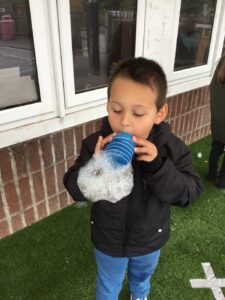
You could also share your results if you wish.

You can look at https://www.greatscienceshare.org/#about-1for more ideas.

We can’t wait to see your pictures.

Thanks so much and keep safe xx


English Home Learning 16th June 2020

Sound words

When a word sounds like the noise it is describing, it is called onomatopoeia.

’Thud’, ‘crash’, ‘bang’, and ’buzz’ are all examples of onomatopoeia.

Onomatopoeia can help to bring a story or poem to life for the reader.

It is often used to add humour as well because the words usually sound quite strange or are fun to say.

Onomatopoeia Bang, Smash and Splatter with music notes
Visit the BBC Bitesize page to see the videos and try the activities!

Maths Home Learning 16th June 2020

Adding fractions with the same denominator

Adding fractions is easy when the denominators (the numbers below the line) are the same.

When the denominators are the same, you are adding fractions that have the same amount of equal parts.

The numerators (the numbers above the line) represent the amount of parts you are talking about.

You can use fraction bars to help you add fractions.

Take a look at these examples.

Example 1:

1/4 + 2/4
 

To represent the answer, you can use a different fraction bar with the same amount of sections. You can then see how many shaded sections there are altogether.

1/4 plus 2/4 = 3/4

The new amount of shaded parts becomes the new numerator.

Do you notice that only the numerator changes? That’s because the numerator is the only part of the fraction that is added. The denominator always stays the same.

So all you have to do is add the top numbers!

Example 2:

Use your knowledge of what happens to the numerator and denominator to solve this question.

2/7 + 4/7 = ?

If you only add the numerators, then 2 parts + 4 parts = 6 parts!

So the numerator changes to 6 and the denominator stays the same!

2/7 + 4/7 = 6/7

To make sure it is correct, you can double-check using fraction bars:

2/7 + 4/7 = 6/7
Go to the BBC Bitesize page to have a go at the activities.

Challenge

CEOP
Parent View - Give Ofsted your view on your child's school
© Holy Trinity CE Primary Academy and Nursery 2026
Shropshire web design by kiskadoo