English Home Learning 16th June 2020

Sound words

When a word sounds like the noise it is describing, it is called onomatopoeia.

’Thud’, ‘crash’, ‘bang’, and ’buzz’ are all examples of onomatopoeia.

Onomatopoeia can help to bring a story or poem to life for the reader.

It is often used to add humour as well because the words usually sound quite strange or are fun to say.

Onomatopoeia Bang, Smash and Splatter with music notes
Visit the BBC Bitesize page to see the videos and try the activities!

Maths Home Learning 16th June 2020

Adding fractions with the same denominator

Adding fractions is easy when the denominators (the numbers below the line) are the same.

When the denominators are the same, you are adding fractions that have the same amount of equal parts.

The numerators (the numbers above the line) represent the amount of parts you are talking about.

You can use fraction bars to help you add fractions.

Take a look at these examples.

Example 1:

1/4 + 2/4
 

To represent the answer, you can use a different fraction bar with the same amount of sections. You can then see how many shaded sections there are altogether.

1/4 plus 2/4 = 3/4

The new amount of shaded parts becomes the new numerator.

Do you notice that only the numerator changes? That’s because the numerator is the only part of the fraction that is added. The denominator always stays the same.

So all you have to do is add the top numbers!

Example 2:

Use your knowledge of what happens to the numerator and denominator to solve this question.

2/7 + 4/7 = ?

If you only add the numerators, then 2 parts + 4 parts = 6 parts!

So the numerator changes to 6 and the denominator stays the same!

2/7 + 4/7 = 6/7

To make sure it is correct, you can double-check using fraction bars:

2/7 + 4/7 = 6/7
Go to the BBC Bitesize page to have a go at the activities.

Challenge

Incredibox!

Good morning!

We’re going to get muscial in this session.

Incredibox is an amazing app that allows you to create music by simply adding a character to a group.

Each character is a different beat, sound or genre of music.

Get mixing by following this link: https://www.incredibox.com/demo/v3 


English Home Learning 15th June 2020

Exploring Poetry

There are many different types of poetry and in this lesson we’re going to listen to, read and write some of our own.

All poems are made up of words. Poems can tell a story or be about a thought or a feeling. They can be serious or silly, but they always have to use words.

Poems often have a rhythm, which is like a beat in music. The rhythm is quick or slow depending on the words the poet chooses.

Poems can use rhyme, which means that certain words have similar end sounds.

For example: ‘Break’ and ‘lake’ ; ‘cat’ and ‘mat’ ; ‘loud’ and ‘proud’ .

Poems can also use alliteration, which is when more than one word starts with the same first letter or sound.

For example: The slimy, sneaky snake slithered silently.

A snake and a cat
Visit the BBC Bitesize page to see the videos and activities.

6 Badges of Summer – Sport – Blue Peter Badge

This week a number of ‘bubbles’ in school will be focusing on the Blue Peter Sports Badge. The age for the badge is 6+.

As a school we can apply for your Blue Peter Badge if you are currently in a bubble. A letter will be going out this week with all details, terms and conditions.If your not in school you can still apply at home.

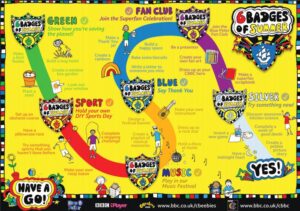
Please visit the website and watch the video explaining about the ‘Sports Badge’.

https://www.bbc.co.uk/cbbc/joinin/bp-sport-badge-2020

https://www.bbc.co.uk/cbbc/joinin/six-badges-of-summer-sport-badge

Get your 2020 Sport badge

Earn your 2020 Sport badge! To get your hands on this limited edition badge, all you have to do is try a new way of getting active, then send in your application form via post or email. This is badge is only available during summer 2020, so what are you waiting for? Get your trainers on and earn it for your collection!

Below are a few ideas a you how you can earn the Blue Peter Badge:

  • Set up an obstacle course
  • Have a pillow race
  • Try something sporty that you haven’t done before
  • Make your own relay baton
  • Complete a skipping or hula hoop challenge.
  • Even the 21 challenge

It is up to the BBC who receives a sports badge, so lets get active and apply for a chance of earning a badge.
How to apply:

For this year’s sport badge, we are asking you to try a new way of getting active! This could be a new sport in your back garden, learning a new skill like skipping or football tricks. Perhaps you have been doing exercise classes at home or tried a new style of dance? The only rules are:

  • You must be trying something new
  • You must be doing a physical activity

Once you’ve tried a new activity, click on the ‘get this activity’ button above to download the form. Once you’ve filled it in (and got a parent/guardian to help), you will need to attach a photo or drawing of yourself doing the activity. Once you’ve done that, you are ready to send it to us! You can send via e-mail or post:

For post, send your application with the correct postage to:

Blue Peter

BBC Bridge House

MediaCityUK

Salford, M50 2BH

Make sure you attach your application and your supporting photo or drawing!

bp-2020-Sport-badge-application

Before you apply:

  • Get a parent to read the full terms and conditions, found here!
  • You must be aged between 6 and 15 years old
  • Make sure you are using the correct 2020 application form, found on this page!
  • When you attach a photo or drawing of yourself trying your new sport, make sure there are no other people in the photo, and you are not wearing your school uniform
  • While social distancing measures are in place, please make sure that you try your new physical activity at home, in the garden or during your hour of exercise only.

https://www.bbc.co.uk/cbbc/findoutmore/bp-attractions-terms-and-conditions

https://www.bbc.co.uk/cbbc/attractions

Thank you and good luck.

Maths Home Learning 15th June 2020

Ordering Fractions

Good morning!

Did you know that you can order different types of fractions?

The two types are called unit fractions and fractions with the same denominator.

Both unit fractions and fractions with the same denominator show us how much of the whole we are talking about, but depending on the numerator and denominator, they show you different amounts.

Did you know

Ordering unit fractions

A unit fraction is a fraction where the numerator is 1. The denominator can be any other whole number. A good way to remember it is by remembering that unit means one.

Quarter showing numerator and denominator

The trick with ordering unit fractions is to look at the denominator.

The bigger the denominator, the smaller the fraction!

Think about a pizza. If you were sharing a pizza between two people, each person would get quite a large piece. They would both get ¹⁄₂.

A pizza in two halves

Now imagine you were sharing the same sized pizza with 8 people. The pizza would have to be cut up into even smaller pieces. Each person would only eat ¹⁄₈.

pizza cut into eighths

You can see that ¹⁄₂ is a larger fraction than ¹⁄₈.

Example 1:

Take a look at these four fractions. They are all unit fractions and they all have different denominators.

ninth, quarter, tenth, third

Let’s look at ordering them from smallest to largest.

Tenth, ninth, quarter and third

There you go! The fraction with the smallest denominator is the largest fraction.

Ordering fractions with the same denominator

When you order fractions with the same denominator, you have to look at the numerator, since the denominator will never change.

You look at the numerator because it tells you how many parts of the whole you have.

Imagine a cake cut up into 8 equal slices. You eat 2 slices, but your friend eats 4. You have had less cake than your friend.

You had ²⁄₈ while your friend had ⁴⁄₈.

Cake

Example 2:

Can you order these fractions from largest to smallest?

five sixths, three sixths, four sixths, two sixths

Which fraction has the largest numerator? Then order the rest in descending order.

five sixths, four sixths, three sixths, two sixths
 Visit the BBC Bitesize page to see the activities.

Long Mynd Celebration Post

Another fantastic week to celebrate! I’ve been send some awesome work so please keep sending me everything you’re doing!

Congratulations to Georgina, Zorni and Owen this week for all your efforts on Mathletics!

Here are you certificates!

LONGMYND_from_05-06-2020_to_12-06-2020

Special congratulations to Georgina for earning a silver certificate this week!

Here is a selection of some of the excellent work I’ve seen this week! Well done everyone who is working hard at home!


English Home Learning 12th June 2020

Bitesize Daily Book Club:

Kensuke’s Kingdom by Michael Morpurgo

Kensuke's Kingdom (Egmont Modern Classics): Amazon.co.uk: Morpurgo ...

Michael’s family decide to travel around the world in a boat. Twelve-year-old Michael is washed up on an island in the Pacific and struggles to survive on his own.

Concept Art Revealed for Feature Film 'Kensuke's Kingdom ...

Whilst there, he meets somebody. But will the stranger help Michael?

Visit the BBC Bitesize page to see the actor, Dolly-Rose Campbell read part of Kensuke’s Kingdom and complete the activities.

Maths Home Learning 12th June 2020

Handling data in football

Good morning! We’re having a break from fractions and looking at data handling today. We’ve done some of this before in class.

Mathematician and TV presenter Rachel Riley introduces the concept of handling data in football. She reminds us how to read a bar chart, why they are useful and some important features to remember when drawing your own.

Footie boots

Being able to present match data in a bar chart is a useful way to display key information and to help interpret a team’s performance.

Watch the videos on the BBC Bitesize page and try the activities on data handling.

Challenge

‘Bubbles’, ‘Masks’ and ‘Rainbows’.

As a number of children have now returned to school. We have settled into our ‘bubbles’.

I would like to share a book with you about being in a bubble. I have also attached an activity to complete together for discussion about returning to school.

Coming_back_to_school_in_a_bubble__A_book_for_children__1_

I am also attaching 2 books by Deana Sobel, ‘Masks’ and ‘Rainbows’. These books are available to help with any discussion your child has with questions and anxiety.

masks

rainbows