English Home Learning 25 June 2020

Creating Characters

We’ve done lots of character creation this year, from dragons to Greeks heroes and monsters!

The myth of Theseus and the Minotaur | Knossos Guides

This is another chance to practise those skills you have learnt and learn more about how authors create their characters.

When authors create a new character they have to know everything about them. This means answering a lot questions about what that character is like.

Heromachine: Golden Age DC Heroes by irishfist123 on DeviantArt

Authors need to know everything about their characters so they know how they will act throughout the story.

They ask themselves questions like:

  • What’s the character’s name?
  • How does the character behave?
  • What do they like to do?
  • How old are they?
  • What do they feel and what are they thinking?

Visit the BBC Bitesize Page to see the videos and activities.

Maths Home Learning 25 June 2020

Parallel and Perpendicular

We see lines everywhere around us all the time, for example on buildings, books, televisions, photo frames, roads etc.

We learnt how to identify some different types of lines in yesterday’s lesson and today we are going to look more closely at identifying parallel lines and perpendicular lines in shapes.

handprint : perspective in the worldPerpendicular line in real life – abyn | Real life, Life, WorldParallel Lines In The WorldReal World Parallel and Perpendicular Lines by Southard Sara | TpT

Parallel lines are two lines that are always the same distance apart and never meet, just like railway tracks.

To show that two lines are parallel, you draw matching arrows on each line facing the same direction.

parallel lines

Perpendicular lines are lines that meet at a right angle (90°), like a corner of a room or the edge of a book.

To show that two lines are perpendicular, you draw the right-angle sign in the corner where the two lines meet.

Perpendicular

Example 1:

Look at the trapezium below.

trapezium

The top and bottom lines are parallel because they will never meet and will stay the same distance apart, no matter how long the lines go on for!

The parallel lines have been marked with matching arrows.

The trapezium also has perpendicular lines, which have formed two right angles. They are marked with the small square symbol in the corners.

Example 2:

This parallelogram has no right angles so no perpendicular lines, but it does have two sets of parallel lines.

parallelogram

The two sets of matching arrows show you which lines are parallel.

How many parallel and perpendicular lines can you see around your house?

Visit the BBC Bitesize page to see videos and activities on recognising the different lines.

English Home Learning 25th June

Good morning!

I would like you to watch the video of the picture book Owl Babies by Martin Waddell:

Look at these pictures of owls, can you collect adjectives to describe them?


Choose your favourite and write a series of sentences to describe the owl. Here is mine:

The fluffy, young owls huddled together on the thin, wobbly branch.

English Home Learning 24 June 2020

National Writing Day challenge

The 24/7 challenge

It’s National Writing Day today and the aim is to get everyone writing creatively!

You are going to take part in a 24/7 challenge.

There are just three rules:

1. You are going to write a brilliant 24-word short story.How to Write a Short Story in 7 Steps

2. Your story must start with the words ‘One day’.

3. You will write it in just 7 minutes!

It’s a challenge, but don’t worry – visit the BBC Bitesize Page to watch the helpful videos and read the tips that will have you writing an amazing story in just 7 minutes!

 Believe In The Power Of Your Imagination

Maths Home Learning 24 June 2020

Describing Lines

We see lines everywhere around us all the time, for example on buildings, books, televisions, photo frames, roads etc.

Did you know that different types of lines have different names?

buildings

Types of lines

  • A vertical line goes up and down.

  • A horizontal line goes left to right.

Vertical and horizontal lines

Why not have a look around and see if you can find any horizontal and vertical lines?

Now have a look at the pencils below. Can you count how many vertical and horizontal pencils there are?

Various pencils arranged in different orientations.

How many did you find? You can see that there are 4 vertical pencils and 4 horizontal pencils.

Visit the BBC Bitesize page to see videos on recognising parallel and perpendicular lines and the activities.

Challenge

English Home Learning 23rd June 2020

Enjoying Reading

An author chooses everything about a book:

  • where it is set
  • what happens
  • who the characters are
  • what those characters are like

This is called authorial intent.

Authors also think hard about what they want their readers to feel when they are reading their books.

When someone reads a book and really likes it, they often read other books by the same author. This is because they enjoy how that author writes and how that author makes them feel.

For example: Lots of people enjoy reading Roald Dahl’s books because they know they’re usually funny, have interesting characters and will be written in a way that makes them feel happy.

Visit the BBC Bitesize page to see the videos and activities.

Maths Home Learning 23rd June 2020

Comparing Angles

An angle is the space between two lines that start at the same point.

We measure angles in degrees. The degree symbol looks like this °. We show it next to a number like this 90°.

Types of angles

Angles can be between 0° and 360° (which is a full circle) and depending on the size of the angle, they are called different things:

A right angle looks like the corner of a square or the edge of a book.

It is a perfect 90°, which is often shown by a small square drawn in between the two lines.

A right angle

An acute angle is an angles that is less than 90°. This makes them smaller than a right angle.

A good way to remember this angle is to think that because it is small, it is “a cute” angle.

acute angle

An obtuse angle is an angle that is bigger than 90° degrees, but doesn’t reach a straight line at 180°.

obtuse angle

When you compare two angles, you have to think to yourself, is it smaller or bigger than 90°?

Example 1:

Look at this shape, known as a quadrilateral (a four-sided, two-dimensional shape).

Angle A is a right angle.

quadrilateral

Which angles are acute angles?

Look carefully at the other angles and compare them to the right angle. Which angles are smaller?

  • B and D are acute angles because they’re clearly smaller than a right angle.

  • That means angle C is an obtuse angle because it is larger than angle A.

Example 2:

Are any of the angles below obtuse?

Angles labelled A, B, C and D

Compare each angle to a right angle again – which are bigger than 90°?

  • A and D are obtuse since they’re clearly larger than a right angle.

  • B and C are acute angles then.

Visit the BBC Bitesize website to see the videos and activities.


English Home Learning 22 June 2020

Reading and Understanding Texts

When you read a text and show you understand it by answering questions, this is called comprehension.

Clip Art of the Reading Children free image

You use comprehension skills all the time in everyday life. For example, when you work out what a sign means, watch a film or listen to a podcast.

You often need to link together facts and clues to properly comprehend (understand) what’s happening in a text.

Here is a simple example of a comprehension question that you might find in an English lesson.

Tommy is wearing a grey jumper, round glasses and a blue hat.

Question: What colour hat is Tommy wearing?

If you can give the answer ‘Tommy is wearing a blue hat’, you have used your comprehension skills and shown you have understood the sentence correctly.

Comprehension becomes more challenging when the text is longer because you need to link together more facts and clues to understand what’s happening.

You have to be an active reader. This means you need to be thinking about what you are reading, as you are reading it.

Man with round glasses,a blue hat and a grey jumper
Visit the BBC Bitesize Bitesize page to see the videos and activities.

Maths Home Learning 22 June 2020

Turns and angles

We are now onto a new topic, Geometry!

Today we are looking at turns and angles.

Angles are all around us. An angle is created when two straight lines meet.

Look at the picture below. Two of the pairs of pencils show angles, can you work out which ones?

an arrangement of pencil

If your answer was the pair on the left and the pair on the right, then you are correct. The pair in the middle does not show an angle because the lines do not touch.

The picture below shows a right angle. This is a special type of angle that is a quarter of a full turn.

Right angle

You can check whether an angle is a right angle by using a set square, like in the picture below.

pencils arranged in a right angle, measured with a set square

Two right angles together make a half turn…

Half turn

So, three right angles make up three quarters of a full turn…

And four right angles make a full circle.

Full turn

Practise

Activity 1

Finding angles in your name

Write your full name in capital letters, like the examples opposite.

  • Highlight all of the right angles – how many are there?Lola James
  • Which capital letter has the most right-angles?

Repeat the activity with one of your friend’s names.

  • Does their name have more or fewer right angles than yours?

Activity 2

Make your own right-angle checker

For this activity, you are going to make your own right-angle checker.

  1. Draw around a round object, such as a tin, to make a circle.
  2. Divide the circle into four equal sections, then cut one of these out, so it looks something like the image opposite.
  3. Finally, turn over your right-angle checker and decorate it however you like – why not add an eye and some teeth?

You now have your very own right-angle checker . Go on a hunt around your house and see how many right-angles you can find. The pictures below give you some good ideas!

Send me pictures of your activities so I can give you Dojo Points!

Challenge

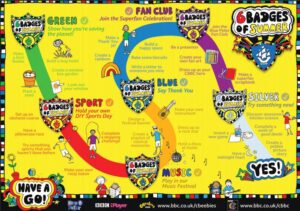
6 Badges of Summer – MUSIC – Blue Peter Badge.

This week in school, a number of ‘bubbles’  will be focusing on the Blue Peter Music Badge. The age for the badge is 6+.

As a school, we can apply for your Blue Peter Badge (if you are currently in a bubble). A letter will be going home with all the details, terms and conditions. If you’re not in school, you can still apply at home.

Please visit the website and watch the video explaining all about the ‘Music Badge’.

https://www.bbc.co.uk/cbbc/joinin/bp-music-badge

https://www.bbc.co.uk/cbbc/joinin/six-badges-of-summer-music-badge

https://www.bbc.co.uk/cbeebies/joinin/six-badges-of-summer-music-badge

Get your 2020 Music badge

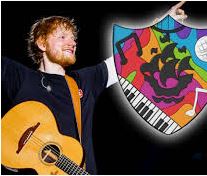
Get your hands on this incredible looking music badge, designed by the one and only music-sensation Ed Sheeran. Fill out the form and send it to the address below. Don’t forget to attach a picture of yourself enjoying music with your entry!

Need some inspiration? Try Bring the Noise!

Do you want a Music badge but no idea where to start? Don’t have a musical instrument at home? Then why not try this Bring the Noise interactive tool! It’s a great way to learn about music and have fun doing it! You can also use it to apply for your Music badge, watch the video for more details.

Here are a few ideas to get you started:

It is up to the BBC who receives a Music Badge, good luck!

Here’s a word from Ed himself:
“I’ve always loved Blue Peter and even got the chance to present the show a while back, so I’m made up that I got to design their first-ever badge for BBC Music Day. Music was really important to me growing up and I hope this badge will inspire more kids to get into it.”

How to apply:

For post, send your application with the correct postage to:

Blue Peter

BBC Bridge House

MediaCityUK

Salford, M50 2BH

Make sure you attach your application and your supporting photo or drawing!

https://childrens-binary.files.bbci.co.uk/childrens-binarystore/cbbc/BP-Musicbadge-form-2019.pdf

Music Badge application

Before you apply:

  • Get a parent to read the full terms and conditions, found here!
  • You must be aged between 6 and 15 years old
  • Make sure you are using the correct 2020 application form, found on this page!
  • When you attach a photo or drawing of yourself trying your new sport, make sure there are no other people in the photo, and you are not wearing your school uniform
  • While social distancing measures are in place, please make sure that you try your new physical activity at home, in the garden or during your hour of exercise only.

https://www.bbc.co.uk/cbbc/findoutmore/bp-attractions-terms-and-conditions

https://www.bbc.co.uk/cbbc/attractions

Thank you and good luck.


A BIT OF ADDED FUN – CAN YOU NAME THE BANDS?