Friday Literacy

I would like your child to read the book again from yesterday. Before they do have a quick recap of the sounds in the story.

ai as in train  (say ‘snail in the rain’)

ee as in see (say ‘what can you see?’)

igh as in high (say ‘fly high’)

oa as in goat (say ‘goat in a boat’)

oo as in zoo (say ‘poo at the zoo’)

oo as in book (say ‘look at a book’)


I have allocated the book to all children on Bug Club. Here is the link

https://www.activelearnprimary.co.uk/resources#bugclub_independent

Here are the pages from the book in case you are unable to access Bug Club.


After your child has read the book, please discuss it with them. I would then like them to answer these questions about the story. Please encourage your child to write the answers to the questions in sentences. Remind your child to use capital letters, finger spaces and full stops. If you can use lined paper, it will help with neatness. If you do not have lined paper, you could draw lines for your child to write on.

I have written example answers in brackets after each question.

1) Who will get on the school bus? (‘Kids will get on the school bus.’ Or ‘Kids will get on.’ Or’ Kids do.’)
2) What can you see on the screen in the coach? (‘You can see a film.’ Or ‘A film’)
3) What does a tram run on? (‘A tram runs on rails.’ Or ‘It runs on rails.’)
4) What animals are loaded onto trucks? (‘Sheep are loaded onto trucks.’ Or ‘Sheep go on trucks.’ Or ‘Sheep do.’)
5) What colour is the slow steam train? (‘The slow steam train is green.’ Or ‘The train is green.’ Or ‘It is green.’

Fantastic Work!

Some more examples of amazing home working…

Konrad created a beautiful rainbow in his garden using chalks!

I love Oscar’s Gruffalo and speech bubble work!

Well done boys, I am very proud of you.

St George’s Day

Today in England it is St George’s Day. St George’s Day is celebrated each year on April 23rd in England. Legend has it that St George was a soldier who defeated a dragon and rescued a princess!


Follow this link to watch how some have children celebrated St Georges Day.

https://www.bbc.co.uk/cbeebies/watch/lets-celebrate-st-georges-day

They can’t celebrate in the same way this year, because they are staying safe in their houses like you are. Perhaps they will complete some activities like I am suggesting to celebrate instead?

Can you use your toys to act out the story of St George and the dragon?

Can you make a shield for St George?

Can you make a scary dragon?

Or perhaps you could make a flag? Or even decorate flag cakes?

Thursday Literacy

Ask your child to identify as many of these sounds as they can. Most will know almost all of set 1 and set 2. Only a few children will have started the set 3 sounds at school.


Today I would like your child to read this book. I have allocated it to all the pupils on the Active Learn Bug Club site.

https://www.activelearnprimary.co.uk/resources#bugclub_independent 

Your child’s access details for this are on the inside of your blue reading diaries. Photos of each page are shown below if you have trouble accessing Bug Club.

These are the sounds your child will need to know to read it.

‘ai’ as in train. Here is the phonics picture and phrase your child knows to help them with this sound. They will say ‘snail in the rain’

‘ee’ as in see. Here is the phonics picture and phrase your child knows to help them with this sound. They will say ‘What can you see? ‘

‘igh’ as in high. Here is the phonics picture and phrase your child knows to help them with this sound. They will say ‘fly high’

‘oa’ as in goat. Most won’t have been introduced to this sound yet, so you will have to teach it to them and probably prompt them when they come across it in the book. Here is the phonics picture and phrase your child will need to help them with this sound. They will say ‘goat in a boat’

‘oo’ as in zoo. Say ‘poo at the zoo’

And finally ‘oo’ as in book. Say ‘look at a book’

These red tricky words are also found in the book: we, go and are.

Perhaps it might be worth finding them in your red tricky word cards and practising them before reading the book.

This story will be a challenge for some children. Encourage them to sound out the words carefully and give them lots of encouragement. Help by reading the words they really cannot read themselves.


If possible, please follow these links to interactive phonics games so your child can continue to practise their phonics and reading skills.

https://www.bbc.co.uk/cbeebies/puzzles/alphablocks-missing-letter-quiz 

https://www.phonicsbloom.com/uk/game/yes-no-yeti?phase=3

I am not setting any writing today, although obviously if your child wants to write something, please encourage this!

Thursday Maths

Today you will need paper, pens, scissors, number cards to 5 and a plate!

Watch and join in with the big numbers song.

Now watch the song ‘5 Little Men in a Flying Saucer’ join in as much as you can!


Explain to your child that this symbol ‘ – ‘  means take away. Another word for this is subtract.

With your child draw and cut out 5 space men. Use a plate as a flying saucer. Lay out your number cards 1,2,3,4,5.

Explain to your child that you have got 5 men in the flying saucer and 5 numbers.

Sing the first verse of the song with your child

5 little men in a flying saucer
Flew round the earth one day
They looked left and right but they didn’t like the sight so one man flew away!

Ask your child to take 1 space man out of the flying saucer. How many are left now? Take away the number 5 off the number card line. Verbally say “5 take away 1 leaves 4”. Show your child how to write out the subtraction 5 – 1 = 4.


Repeat the activity with the next verse of the song

4 little men in a flying saucer
Flew round the earth one day
They looked left and right but they didn’t like the sight so one man flew away!

Ask your child to take 1 space man out of the flying saucer. How many are left now? Take the number 4 card away and say “4 take 1 away leaves 3”. Work with your child to write out this subtraction.

Sing the next verse…

3 little men in a flying saucer
Flew round the earth one day
They looked left and right but they didn’t like the sight so one man flew away!

Ask your child to take 1 space man out of the flying saucer. How many are left now? Ask your child to take away the number 3 card and encourage them to say “3 take away 1 leaves 2” Encourage your child to write out the subtraction independently.

Repeat the activity with the last two verses!

2 little men in a flying saucer
Flew round the earth one day
They looked left and right but they didn’t like the sight so one man flew away!

1 little man in a flying saucer
Flew round the earth one day
He looked left and right but they didn’t like the sight so one man flew away!

How many space men are left in the flying saucer at the end? How many numbers are left in the number line? Explain to the children that zero is the number that represents nothing.

“There are no spacemen left in the flying saucer. There are zero spacemen in the flying saucer”


Amazing Home Learning!

I wanted to share some more fantastic work I have been sent. Thea has worked very hard on her rhyming words.

Elsie wrote sentences about ‘Whatever Next’ and drew a beautiful rocket picture.

Keedie is missing her friends. She drew pictures of some of them.


World Earth Day – Wednesday 22nd April 2020

Hi everyone, I hope you are all well.

Today is Earth Day and linked with our Geography, I would like us to join together to celebrate Earth.

What is Earth Day?
Earth Day, celebrated on 22nd April each year, is the annual event dedicated to awareness about the various environmental challenges that face our planet.
Co-ordinated by the Earth Day Network, 193 countries around the world have their own version of celebrations.
In many places, Earth Day forms part of Earth Week: a longer period of climate awareness that includes activities and campaigns.
The 2020 version of Earth Day will be the 50th anniversary of the event.

History of Earth Day
The idea of Earth Day first originated among the people fighting the 1969 Santa Barbara oil spill.
It is said that American senator Gaylord Nelson, one of the main proponents of the event, was flying over the disaster in an aeroplane and was so shocked by the scale of it that he decided to create a Day to help prevent future cases.
The first Earth Day, held in 1970, saw millions of people around the world roam the streets with the desire to make a stand for environmental change. Many think of this as being the beginning of modern environmental activism.
Since then, the Day has gone from strength to strength, with the Internet helping to distribute its message further than was ever possible before.
Its crowning achievement perhaps came in 2016, when the Paris Agreement came into force for the majority of the World’s countries, ensuring increased environmental protection.
Earth Day is now the world’s largest civic event.

How is Earth Day celebrated?
Each year, Earth Day has a variety of themes, signifying a new focus on a particular environmental concern.
The theme for Earth Day 2020 is climate action. Climate change represents an enormous challenge to the future of humanity and the life-support systems that make our world habitable.

How are Holy Trinity celebrating?

Below you will find 10 different activities, you can choose how many activities you would like to complete, but it would be fantastic is everyone completed at least one.  Some activities are aimed towards EYFS and Key Stage 1 and some towards Key Stage 2, however it is up to you which activity you would like to choose.  Work alongside your grownups at home, have fun together, but please make sure you ask permission before using any equipment.

Once you have completed an activity please make sure you take a photograph of your creation and send it either to myself or your teacher.  My email address is Lawley@holytrinitycepa.co.uk

Activity 1

Thinking about what Earth Day is for and its link to Climate Change this year, you could design a poster advertising Earth Day.  This could show why we celebrate Earth Day, what Earth Day covers and the beautiful and wonderful things about Earth.

Activity 2

Make a model of the Earth.  You could make this out of anything you have at home – junk modelling, Paper Mache, playdough, absolutely anything.
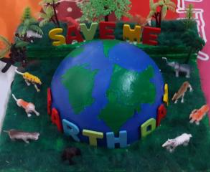
Activity 3

You could have a go at recycling yourself by using empty packaging to plant seeds to grow.
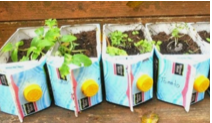
Activity 4

Greta Thunberg started a campaign about climate change.  Write a script to interview Greta to find out more about her campaign and why she started this.  Click on the link below to find out more information about Greta through BBC Newsround.  Once you have completed your script you could record the interview with a member of your household pretending to be Greta.

https://www.bbc.co.uk/newsround/48022108

Activity 5

Celebrate Earth Day by collecting natural items from your garden, then create a beautiful piece of art.
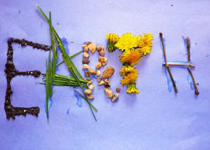
Activity 6

Research the impact of pollution, in particular the positive effect the current lockdown has had on the Earth’s pollution.  For example, parts of the Himalayan mountain range can be seen in parts of India for the first time in 125 years due to the smog lifting.   Focus your research locally, nationally and globally, then write a newspaper report on this.

Activity 7

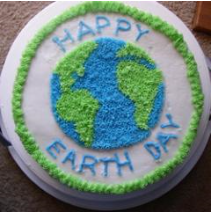
Design and bake a cake to celebrate Earth Day.  Design this first, drawing and labelling how you want your cake to look, followed by a list of ingredients you will need.  Before baking, research where the ingredients come from and their journey to get to your house.
Activity 8

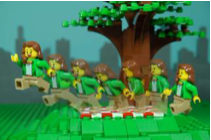
Create an animation about climate change, use voices and sound effects!  You can use Lego, playdough or anything from around your house.
Activity 9

Create a song or poem about Earth Day with a focus on climate change.  Research and find out as much as you can so you can include these facts in your song or poem.  You might even want to create a special artistic background  for when you record your song.

Activity 10

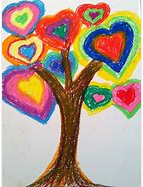
Using the art techniques used by Kandinsky, create a piece of tree artwork or think of your own design linked to climate change.  Here are some examples of work following Kandinsky’s style.

Have fun with this, remembering the reasons behind Earth Day.  I am looking forward to seeing your photographs and sharing them with everyone.

Stay well and safe, Mrs Thompstone

A few more ideas….

At this unsettled and unusual time, it is very easy to get caught up in all the sad news we are hearing. As a school, we are trying to go some way to counter act this by actively looking for happy news stories. Older children will be able to watch the news, or search for happy news stories online. Obviously things will have to work a little differently with the youngest children.

So, I have decided to do a ‘Happy News Shout Out’ for them. If any of your children do something new that has made you as a family feel happy, please share so we can post it in the happy news! The example of a parent telling me that their child can now ride a bike without stabilizers is a great example of the type of news I am hoping for.

This is an idea from Mrs Owen. She made a rainbow in her garden by using different coloured clothes. Can you do the same?

She has added numbers to the side of hers and used it to play a game. She threw a ball and then looked to see what number it landed on the rainbow.

Here is the playdough recipe I use again.

Can you use the play dough to make a smiley face picture?

Wednesday Maths

Today you will need up to 20 small items, such as small Lego cubes, raisins, pieces of dry pasta, small toy animals or small figures. You will also need number cards with numbers 0-20 (from home learning pack, or ones you have home made).

Start by watching the ‘Numberblocks’ count to 20. Follow this link to the BBC iplayer to watch it.

https://www.bbc.co.uk/iplayer/episode/m0006s5q/numberblocks-series-4-14-i-can-count-to-twenty 

Ask your child to lay out their number cards to 20 in order. Ask them to use their ‘magic pointy finger’ to point to specific numbers.

They children love it if you use silly voices or have them point to a small number immediately followed by a big number so their finger is moving all over the number line quickly. I also ask them to use their finger to point to numbers in a sequence but then quickly change it to try and catch them out. They will have automatically pointed to what they think will be the next number! For example, I might ask them to point to numbers 13,14,15,16 and pause, at this point they will point to 17, but I will go back down and ask them to point to numbers 15,14,13.

This game can be changed so the children say the numbers and you have to point at the number line. Deliberately get some wrong by pointing to an incorrect number. Do they notice?

Another way to adapt the game is by you pointing to the numbers and the children have to say what number it is. Again move your finger quickly up and down the number line, jumping all over the place so that the children really have to look and concentrate on where you are pointing.

These games familiarise the children with numerals to 20 and the sequence of numbers to 20.

Using the small items, ask the children to grab a handful. Ask them to count how many items they have. Can they find and point to that number on the number line? Ask them how many items they would have if you gave them 1 more. Show this by using your finger and jumping it 1 more number along the line (similar to Tuesday’s Maths work). Give your child 1 more item and ask them to count how many they have now to check they were right.

Repeat this a number of times, each time asking your child to grab a handful of items, count them, point to the corresponding number and then add one more by using the number line. Give them 1 more item to add and then count to check.

Cheeky Challenge!!! If your child is confident adding 1 more using the number line, challenge them by asking them to count a handful of items and find the number as before, but then ask how many they would have if you gave them 2 more or 3 more. Encourage them to use their finger to jump along the number line and then actually give them 2 or 3 more items and ask them to check by counting.

Wednesday Literacy

Please ask your child to practise writing their full name today. Remind them to only use a capital letter at the start of their name.

Watch the story ‘Whatever Next’ again.

We have worked on speech bubbles in school. Today I’d like the children to write speech bubbles showing what they think the characters in the story are saying. It doesn’t matter if it is not exactly the same as in the story, as long as it makes sense!

Here are the pictures I have added speech bubbles to.

Show them to your child and discuss each picture. What do they think the character is saying?

On a piece of paper, draw a speech bubble and draw some lines for your child to write on.

Ask your child to write down what the character in the first picture is saying. Remind them of their phonics, capital letters, full stops and finger spaces. Repeat with the other pictures.

Cheeky Challenge!!! Look at these familiar characters. What might they be saying? Can your child write these in a speech bubble shape?