Maths Home Learning 18th May 2020

Identifying the fraction shaded

Fractions can be shown in different ways, including within shaded shapes. This can be a useful way to see them.

Here is a square that has been divided into 4 parts.

You can see that 1 part of the 4 is shaded.

As a fraction we can show that as ¼ (one quarter).

quarterone quarter showing numerator and denominator
  • The top number is called the numerator. This shows how many parts you have (1 in this case).

  • The bottom number is called the denominator. This shows you how many parts the whole object has been divided into (4 in this example).

    ¼ is also called a unit fraction. This is any fraction with 1 as its numerator.

What fraction has been shaded in this shape?

You can see 1 part out of 6 has been shaded or ⅙

If we were to shade in 2 more parts, what fraction would be shaded now?

The answer is ³⁄₆

Visit the BBC Bitesize page to see the video and activities where you can practise identifying the shaded amount.

If you think you’ve mastered that, try my challenge!

Challenge

Home Learning – Tuesday 19th May

Good Morning Earl’s Hill!

I hope you are doing fine and well! Parents – I am saying sorry before today’s literacy task!

Today for our Literacy task, I would like you to make a potion! You are going to pretend to be a witch or a wizard! Create a potion from ingredients around your house (that you are allowed to). You can use things from outside your house too!

Before you start, you need to think about what this potion is for. Does it make your hair grow? Does it give you a super power? Does it create an object?

When you’ve finished creating your potion, you need to write the recipe. Your recipe should include an ingredients list and numbered instructions on how to mix it. Make sure you use your bossy verbs at the beginning of the sentence. For example “Pour the cream into the big bowl.” These words should be able to stand on their own as a command. We know how to be bossy when giving instructions as we have done it a lot in class.
Don’t forget to write down what your potion does in the title!

Try and encourage your child to “hold the sentence”. This is where we say the whole sentence out loud, count the words and try and write it down without prompts for the next word.

Reception Maths: While you are making your potion, talk about the measurements that you are using. Is this fuller or less full than before? Can you use half full as a measurement? Once you’ve poured everything out, how do we describe this? Use different containers and measurements while you are making your potions and use the language of capacity.

Year 1 – You can also do the above activity as you are making you potions. But also here is the BBC Bitesize.

Have lots of fun and take lots of pictures!

Tuesday Additional Ideas and Science

Make Bus Tickets and play Buses

Your child watched a video about going on a bus in Literacy. Perhaps they could make bus tickets for each member of the family?  Or perhaps for their soft toys? They could role play going on a bus with their toys by siting them one behind the other. Your child could be the bus driver, giving each toy their ticket. They could use a plate or saucepan lid as the steering wheel!

Exercise!

Talk to your child about their breathing. Is it fast or slow?

Ask them to place their hand on their heart (on their chest). Can they feel it beating – slow and steady. Emphasise that both their breathing and their heart rate are slow and steady. Explain that it is because their bodies have not been moving quickly. Their bodies have been moving in a slow and steady way and so their breathing and heart rate are slow and steady.

Choose some lively music to dance too. Encourage your child to move quickly, the aim is to increase their breathing and heart rate!

When your child is slightly out of breath, ask them to stop and think about their breathing now. How has it changed? Can they feel their heart beating in their chest? How has that changed? Explain that their heart is beating faster now to pump their blood around their body. Their breathing is faster because they have been exercising and they need to get more air (oxygen) into their bodies.

In Reception, the aim is for your child to observe and notice the changes of exercise on their bodies. A simple coversation about the changes will support this. They will learn more about the science behind these changes as they progress through school.

Tuesday Maths

Warm up by singing this song and joining in with the actions!

Start by laying your number cards face up on the floor. Ask your child to ‘move like a bus to number 15’, ‘like a train to 9’, ‘like a plane to 14’ and so on. If you feel your child is still uncertain with certain numbers, keep asking them to move to that number so they become more familiar. If you feel your child is confident with these numbers, make your own number cards from paper and select a few numbers (ten or so) up to 30, 50 or even 100.

You will need one or two bus templates again today depending on the ability of your child. Two buses will allow your child to work with larger numbers. You will need some small toys, figures or counters. Your child will be writing out addition calculations so they will need paper and pencils to do this.
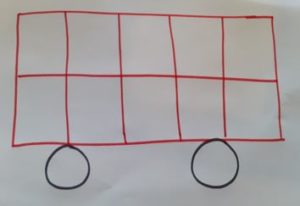
You will also need your number cards again. Lay them face down.

Ask your child to turn over a number card, put that many people on the bottom layer of the bus. If it is a large number because your child is more confident with numbers they may almost fill up the spaces on the bus.

Ask your child to write down this first number followed by the ‘+’ symbol. (for example if they turned over a 5 card and then put 5 counters on the bus they would write 5 + onto their paper)

They then turn over another number card. What number is it? Ask your child to add this amount of toys, figures or counters to the top layer of the bus (or the second bus template if needed).

Ask them to write down the second number.  (so if it was a 4 number card this time, they would add 4 counters onto the bus and continue writing out their calculation so it now looks like this 5 + 4 )

Ask your child to count the total number of toys, figures or counters and then write the answer on their calculation. (It now looks like this 5 + 4 = 9)

Repeat this activity a number of times until your child is confident to work independently or with minimal support.


Tuesday Literacy

Watch this clip about Mr Tumble. He goes on a bus ride! Lots of different people get on the bus with him.

Today I’d like you to create a story map about the video clip. Start by drawing a simple road and bus on your paper like this. Or ask your child to draw it. Please don’t draw the road signs on it yet though. You may need to tape two pieces of paper together, or if you are working in a book, use a double page.

At the start of the road, draw a road sign and number it 1. Ask your child to write who got on the bus first, next to the road sign (Mr Tumble).

Ask your child who got on the bus next? (Aunt Polly) A bit further along your road, draw another road sign (2) and ask your child to label this ‘Aunt Polly’.

Follow this with another road sign for ‘Lord Tumble’. Your road story map should now look similar to this.

Ask your child what happens at the end of the story.  Draw a picnic at the end of the road. Ask your child to write the sentence   “The friends had a picnic” as independently as possible. They should be fairly accurate sounding out all the words correctly. They will probably miss out the ‘i’ in friends, most likely spelling it ‘frends’. This is ok. I really want them to work on sounding out and writing the words by themselves. They can spell the tricky word ‘the’. Remind them to use capital letters, finger spaces and full stops.

Please share a story with your child today.

Mrs Taylor’s Virtual Classroom!

Hey Earl’s Hill!

I have been busy making something super fun and exciting for you! I have been creating our very own Virtual Classroom!

You can click on the pictures and they will take you too all of our websites!

Have a little look around and let me know what you think!

Mrs Taylor’s Virtual Classroom

Monday 18th May Stiperstones Home learning

Good morning Stiperstones – I hope you had a great weekend!

Maths – Today we are starting a new unit on Measurement. Kilograms and Kilometres.

Year-5-Summer-Block-4-Step-1-PPT-Kilograms-and-KilometresYear-5-Summer-Block-4-Step-1-VF-Kilograms and Kilometres

English https://www.bbc.co.uk/bitesize/articles/zkmkd6f

Science How plants reproduce   https://www.bbc.co.uk/bitesize/articles/znghnrd

Highlight and right click on the links above – they will take you to the correct pages.

Hope you all have a good day!

Maths Home Learning 18th May 2020

Introduction to fractions

Fractions Explained - A Guide for Parents

Fractions always show parts of a whole amount.

For example, if I have ½ of something there are 2 equal pieces and I have 1 of them.

fractions pizza slices clipart pizza fractions clip art by liljax ...

A great way to begin looking at fractions is using a pizza or cake! Get your chef hats on the make your own pizza or bake a cake. Then you can begin slicing it in equal parts and talking about the fractions you make each time. You can use this Powerpoint to help you:

t-n-927-pizza-fractions-powerpoint_ver_5

Visit the BBC Bitesize Page for more videos and activities to watch and try.

Finally, if you think you’ve mastered fractions, can you answer my challenge questions below?

Challenge

CEOP
Parent View - Give Ofsted your view on your child's school
© Holy Trinity CE Primary Academy and Nursery 2026
Shropshire web design by kiskadoo