English Home Learning 30 June 2020

Coordinating Conjunctions

Conjunctions are joining words that link together parts of a sentence.

Coordinating conjunctions are used to join together two clauses in a sentence.

These two clauses still need to make sense on their own though – they have equal importance.

For example: I had a terrible cold. I stayed in bed.

You can add the coordinating conjunction ‘and’ between these clauses so it makes one sentence.

For example: I had a terrible cold and I stayed in bed.

The three main coordinating conjunctions are:

  • and
  • but
  • or

However, there are seven coordinating conjunctions in total. You can use the word FANBOYS to help you remember them all:

For, And, Nor, But, Or, Yet, So

A boy is sleeping
 Visit the BBC Bitesize Website to see the videos and activities.

Maths Home Learning 30 June 2020

Recognising 2D Shapes

What are 2D shapes?

2D shapes are everywhere!

For example, windows are usually shaped like rectangles and clocks are shaped like circles.

2D shapes are flat and all have different properties.

Clock

Properties are the qualities that a shape has. Examples of shape properties are:

  • number of sides
  • number of angles (corners)
  • length of sides
  • types of angles (acute, obtuse, right-angle)
  • perpendicular and parallel lines

Take a look at these shapes and their properties:

Triangles

All triangles have 3 sides and 3 angles.

However, different triangles have different properties, depending on how they are drawn. You have to look very carefully to see what is different.

For example, compare these two triangles:

Triangles

Like all triangles, both have 3 sides and 3 angles.

However, the yellow triangle’s sides are all the same length and the angles are all the same size.

The green triangle has a right-angle and all the sides are a different length.

Quadrilaterals

A quadrilateral is a shape with 4 sides and 4 angles.

These are some examples of quadrilaterals and their properties:

Square

Square

  • Sides all equal length.

  • Angles all right-angles (perpendicular lines).

  • 2 pairs of parallel lines.

Rectangle

Rectangle

  • 2 sides longer than the others.

  • Angles all right-angles (perpendicular lines).

  • 2 pairs of parallel lines.

Trapezium

Trapezium

  • 1 pair of parallel lines.

  • 2 sets of equal angles.

  • 2 lines equal length and 2 that aren’t.

Kite

Kite

  • 2 pairs of equal sides.

  • 1 pair of equal angles.

  • No parallel lines.

Regular polygons

These are shapes that have all equal sides and equal angles.

Pentagon

Pentagon

  • 5 equal sides and angles.
Hexagon

Hexagon

  • 6 equal sides and angles.

  • 3 pairs of parallel lines.

Heptagon

Heptagon

  • 7 equal sides and angles.
Octagon

Octagon

  • 8 equal sides and angles.

  • 4 pairs of parallel lines.

Irregular polygons

These are shapes that have sides and angles of different sizes.

You can always identify the polygon by how many sides it has, e.g. a pentagon is always a shape that has 5 sides.

Example:

Irregular polygon

This irregular pentagon has sides and angles that are different lengths and sizes.

It has two right angles and one pair of equal sides. The other 3 sides are different lengths.

Visit the BBC Bitesize page to see the videos and activities.

Tuesday 30th June Stiperstones and Hawkstone’s Home learning

Good morning. Hope you all enjoyed your french day yesterday?

Today is Italian day and we are making pizza!

English – Create an advert persuading everyone to buy your pizza! Don’t forget to give your pizza a name, price and some alliteration – similar to what you did to advertise your Theme Park. Look at the Success criteria to ensure you have included everything you need.

Spellings Word Search

Cursive Handwriting Practice Sheet

https://classroomsecrets.co.uk/multiply-by-10-100-and-1000-homework-extension-year-5-decimal/

Enjoy your day and send me some pictures if you get to make your pizza!

Home Learning – Tuesday 30th June

Good Morning!

English

This week we are going to be looking at Rainbow Fish! This is such an amazing story! If you would like to read it yourselves here is a PowerPoint: Rainbow Fish Story

If you would like to listen together, here is the video:

Mild: 

Print off these pictures of the characters or make your own. The-Rainbow-Fish-Puppets

Stick them to sticks or to your fingers and act out the story. Can your child remember what the rainbow fish says to the the little blue fish? What about the octopus? Ask your child, what comes next and see if they can remember! 

Medium: 3 Boxes

Create a storyboard for the story of The Rainbow Fish. After you have read the story, ask your child what happens at the start, middle and the end of the story. Draw a picture for each part and then have a go at writing a sentence for each. 

Spicy: 6 Boxes

As above, but break up the story a little bit more. Ask your child what happens at the every beginning, then why does the little rainbow fish become upset? 

Write a full sentence in each box. Don’t forget full stops, capital letters and finger spaces.  

Maths

Ted has just made his lunch when Pup came over. 


Mild: When you have something to eat. Ask your child to show you how they could share their food. Show them different ways of breaking the food up. Is this fair? 

Medium: (Have a look for Spicy as well)

Ted wanted to share his lunch with Pup so he decided to cut it in half. 


Ask your child how you think Ted should cut his sandwich in half. 


This is how Ted decided to cut his sandwich. Is there another way to cut his sandwich in half?


Next he cut his banana and his apple. How should he cut those? If you have those fruit, have a go at showing an adult where to cut. 


Did he share them fairly? Is there another way to cut his lunch in half? 


Spicy: 

Next Ted and Pup share some crisps and some other small foods. Can you count out 4 crisps (or any other small countable food – grapes, sweets, biscuits). Can you share them so that Ted and Pup each have half? 

Can you do this with: 2   –   6    –    8   –     10? Now try with 5. Why can’t you share with equally with 5? Are there any other numbers that you can’t share in half equally? 

Cheeky Challenge: Do you know what a quarter is? Can you cut your sandwich into quarters? Can you share your crisps with four people? 

Extra Activity

All you need for this is an old CD, some glue, some card, a sharpie or other permanent marker and some shiny things to stick on top!


English Home Learning 28 June 2020

Using Prefixes

Prefixes are groups of letters that are added to the start of words to change their meaning.

Most prefixes mean a similar thing when they’re added to different words.

  • un- and in- usually mean ‘not’.

For example: unhappy, unlocked, unfair and intolerant, incapable, inconsiderate

  • dis- and mis- usually have negative meanings.

For example: disagree, disobey, misbehave, mislead

  • re- usually means ‘again’ or ‘back’.

For example: redo, reappear, redecorate

  • For example: subheading, submarinesub- usually means ‘under’.

There are spelling rules to follow when you add prefixes to words.

Visit the BBC Bitesize page to see the useful videos and exciting activities for prefixes!

Bonjour tout le monde :)

Bonjour Ercall, I hope you all had a great weekend.
In school we are having a french food day. We will be making crepes, here is a how to video – https://www.youtube.com/watch?time_continue=3&v=bX6ghyT6Ig0&feature=emb_logo
We will then be writing up the ingredients and method for our English.
Here is another video you may want to look at – https://www.youtube.com/watch?v=gcMppC2W-gg&feature=emb_logo.

The work packs are ready for those children who have requested them. Please feel free to hand in any work you did last week.

I have been thinking of having an extra zoom call tomorrow due to the popularity on Friday. Can you let me know if you are interested.

Below is this week’s timetable:
 wb 28.6.20
Have a great day 🙂
Like
Comment

Maths Home Learning 28 June 2020

Drawing lines and Shapes Accurately

Drawing accurately with a pencil and ruler is a great skill!

How to draw straight lines with a rule? - Wonkee Donkee Tools

Visit the BBC Bitesize page to see the videos and activities on drawing accurately.

Challenge

Monday 29th June Stiperstones and Hawkstone’s home learning.

Good morning to you all. hope you had a wonderful weekend.

This week our topic is Food Glorious Food!

We are going to have some themed food days and today is French Day.
Here is a clip on how to make crepes.

English – Can you design an instruction card on how to make these wonderful crepes? You will need subtitles such as ingredients, equipment and method.

If you have the ingredients – this will be your afternoon activity.

The next clip is some French words around the topic of food.

Maths – More work on subtracting decimals

Clip – https://kids.classroomsecrets.co.uk/resource/subtract-decimals-with-different-decimal-places-video-tutorial/

Interactive game https://kids.classroomsecrets.co.uk/resource/subtracting-different-decimal-places-game/

https://classroomsecrets.co.uk/subtracting-different-decimal-places-homework-extension-year-5-decimals/

Hope you all have a great day!!!! xx

Home Learning – Monday 29th June

Good Morning!

As more children return to school, Mrs Allcock and Mrs Meddins are teaching full time and so I have taken responsibility for posting the home learning tasks because I am not currently assigned to a bubble.  They will be a little different to what we may have been used to as they will span from Nursery up to Year 1. You know your children best so it’s completely up to you to choose which level of activity your child completes.

There are three levels of difficulty: Mild, Medium, Spicy. I’ve done this more as a guide for the adults than for the children. They are not hard and fast for each year group, but more of a guide. For Year 1s, the mild level can be used as a starting point to before moving onto either the medium or the spicy levels.

Literacy

Watch this video: (you don’t have to watch all of it – just a few minutes)

Mild: Encourage your child to mime preparing for the dive underwater. Get your swim suit on and your mask. Here is a picture of a scuba diver to help you. 
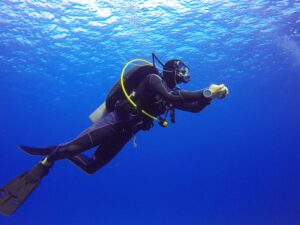
Once you have got ready, play the video and pretend to swim along as you watch. Talk about the fish you see. Point out exciting and interesting things. Encourage your child to talk about how it might feel under water. What sounds can you hear? 

Try and expand their vocabulary by suggesting words that they may not have used like: freezing, bubbling, exciting. 


Medium: 

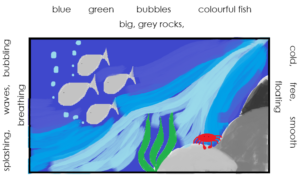
Ask your child to draw a picture of their favourite part of the video in the centre of their page. Leave a wide border around the outside of the paper. 

Once they’ve done this, ask them to think of words that describe what they can see, hear and how they might feel. Write these around the outside of the page. 

Here is my amazing example: 


Spicy: 

Ask your child to choose their favourite part of the video. Pause the screen so that they can look at the picture. 

Ask your child to write three sentences: 

Under the sea I can see …

Under the sea I can hear … 

Under the sea it feels… 

As an extra cheek challenge, encourage your child to include the words “and” or “because” in at least one of their sentences. 

Maths: 

Have a look at the sheet for each level. Your child needs to count the scales.

Mild: Rainbow Fish Mild

Ask your child to count how many spots there are of each colour. Can they match the number to the correct numeral? 

Medium: Rainbow Fish Medium

We are looking at tallying today. A tally is a way of counting how many there is of something. You draw a straight line for each item and then across when you reach the fifth. Then you start a new set.

Here is a video:


Ask your child to pick their favourite colour and create a tally for how many there are.

Spicy: Rainbow Fish Spicy

As above but this time, create a tally for each colour and then find out which has got the most and the least! 

Cheeky Challenge: How many more has the top got, than the bottom? What is the difference? 

Extra Activity

Have a go at some underwater Yoga:

Clee Home Learning

Thank you so much for all the support you have given your children with their home learning over the last few months. It has been a challenging time for us all, and your efforts to continue to provide education for your children at home have been amazing. I have been so grateful for the communication I have had with many of you and thank you for your kind words of support. Clee Class have all been super stars and I am honoured to have been their teacher, even if their time in my classroom was cut short. I am so proud of all the children and really miss seeing them.

However, we are having to look forward and plan ahead for the next academic year. This, as you can imagine in the current situation, is taking a great deal of thought, time and effort. I am working with the Senior Leadership Team to ensure transitions into Nursery, Reception and Year One happen as smoothly as possible within the current government guidelines.

As the bubbles of children attending school are growing, so too are planning requirements for these pupils.

The decision has therefore been made to combine the home learning for Nursery, Clee and Earls Hill. Mrs Taylor is not currently assigned to a bubble at school and so will be taking over the planning and posting of the home learning curriculum. She will be liaising with both myself and Mrs Meddins. The Nursery and Clee Class email is still operating and I will be checking and responding to emails. If you have any questions or queries, please do not hesitate to contact me.

Thank you again for all your support. Mrs Allcock


CEOP
Parent View - Give Ofsted your view on your child's school
© Holy Trinity CE Primary Academy and Nursery 2026
Shropshire web design by kiskadoo