Maths Home Learning 9th July 2020

Measuring Capacity

Remember

  • Capacity is the amount of liquid a container can hold.

  • Volume is how much liquid is in the container.

We can measure both in millilitres and litres.

Remember

Measuring in litres and millilitre

A litre is much more than a millilitre.

1 litre = 1000 millilitres

We shorten litres to ‘l’ and we can shorten millilitres to ‘ml‘.

So we might also say:

1 l = 1000 ml

Practise

Activity 1

What’s left in the house?

Find as many containers in your kitchen as you can that are holding liquids, such as a bottle of milk or squash.

Check how much liquid they hold when they are full (you should be able to find this on the packaging.) Estimate how much liquid is left in each container.

If possible, use a measuring jug for each to check your estimates.

Maths with Parents logo
Different containers

Activity 2

Drinks time

Using a measuring jug, make yourself a drink. For example, you could use the recipe below:

  • ½ litre orange juice
  • 50 ml cranberry juice
  • 200 ml water
  • 5 ml lemon juice

Why not adapt this recipe to use the drinks you have at home?

 Visit the BBC Bitesize page to see the video on measuring capacity.

Long Mynd Zoom Meeting

Hello!

We are planning a class Zoom meeting for next Wednesday!

This will be a great opportunity for your child to see some of their classmates and their teachers. If you don’t already have it, you will need to download the Zoom App first. The meeting will be at 10am on Wednesday the 15th July.

If you don’t already have the app, you will need to download it before the meeting. Following this link to join the meeting and enter the meeting Id and password. Your child will also need a pen and paper as we are hoping to play some games.

We can’t wait to see you!

Meeting ID: 293 362 4186

Password will be sent via Class Dojo, if you can’t access your Dojo account please email longmynd@holytrinitycepa.co.uk and the password will be sent to you.

English Home Learning 8th July 2020

Writing Headlines Using Alliteration

Newspaper articles use headlines to attract readers.

Headlines are written at the top of an article, like a title, and hint at what the article will be about.

Newspaper headlines should be short, snappy and grab the reader’s attention.

They do this by:

  • Giving some information about the story.

  • Using powerful words that make an impact.

  • Using alliteration so the title sounds catchy.

  • Using humour to make the audience laugh.

Newspaper cover with several headlines

You are going to use alliteration in your headlines today.

Alliteration is when words close together in a sentence start with the same sound.

For example: Sammy the slippery snake went sliding by.

Visit the BBC Bitesize page to see the videos and activities.

Maths Home Learning 8th July 2020

Add and Subtract Mass

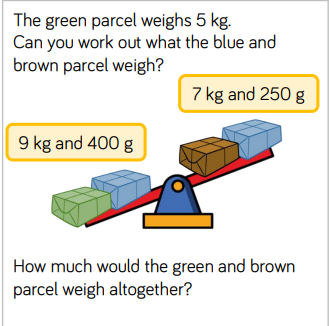
Adding and subtracting mass is the same as simply adding and subtracting normal numbers, but you must remember to put the measurement (kg, g) after the numbers.

The mass of the grapes is 100g.

The mass of the bread rolls is 300g.

I know that 100 + 300 = 400.

The total mass is 400g.

Visit the BBC Bitesize page to see the videos and activities for adding and subtracting mass.

Challenge
Maths Home Learning 7 July 2020

Comparing Mass

The mass of an object tells you how heavy something is. You use grams (g) and kilograms (kg) to measure mass.

  • Grams are used when you weigh a lighter item, like an apple or banana.

  • Kilograms are used when measuring the mass of a heavier object, like a box of toys or yourself.

1000 g = 1 kg

Top tip

You can use the greater than (>) , equal to (=) or less than (<) signs to help you compare the mass of two objects.

Don’t forget, the tip of the arrow always points to the smaller number.

Top tip

Example 1:

Look carefully at the measurements shown on the scales.

500g of doughnuts and 5kg of fruit

The mass of the doughnuts is 500 g, while the fruit weighs 5 kg. But are the doughnuts or pineapples heavier?

Since both foods are being weighed in different units, it would make sense to convert them so it’s easier to compare. Let’s convert them both to grams.

The doughnuts are already in grams, so you only have to convert the fruit. We know there are 1000g in 1 kg. So:

5 kg = 5000 g

Now you have to compare 5000 g and 500 g – which is the heavier mass?

5000 g > 500 g

5000 g is heavier than 500 g, so the fruit is heavier than the doughnuts.

Example 2:

Look carefully at the measurements shown on the scales.

White shoes 1000g and black shoes 1kg

What do the scales say that the shoes weigh?

The scale with the white shoe points to 1000 g while the black shoe weighs 1 kg.

Just like the last example, it would be easier if you were comparing two measurements with the same units.

Let’s covert 1000 g into kilograms:

1000 g = 1 kg

So the white shoe and the black shoe both weigh 1 kg. Their mass is the same.

Example 3:

Kemi and Mariella both bought a bag of sweets. Kemi’s bag weighed 1300 g and Mariella’s bag had a mass of 1 kg and 500 g. Who had the heavier bag?

Turn the measurements into ones that share the same units.

1300 g = 1 kg and 300 g

It’s now easier to see who has the heavier bag of sweets:

  • Kemi had 1 kg 300 g
  • Mariella had 1 kg 500 g

Mariella bought the heavier bag of sweets.

1300 g < 1 kg 500 g

Visit the BBC Bitesize page to see the videos and activities on comparing mass

Challenge

English Home Learning 7 July 2020

Newspaper Reports

Newspaper reports are printed in newspapers, or published online, to keep us informed about important things that are happening all around the world.

When you are writing a newspaper report, you should:

  • Include a short and snappy headline (title).
  • Write a sentence at the start to sum up what the story is about.
  • Write in the third person (he, she, they).
  • Write in the past tense (as if it has already happened).
  • Use paragraphs to make the text clear and easy to understand.
  • Include quotes (other people’s thoughts and opinions about the subject).
  • Include facts about what has happened using the 5 Ws: what, where, when, who, why?

You could also include a photo with a caption to give the reader more information.

It’s important not to confuse facts and opinions when you’re writing a newspaper report.

Facts are the true details about what has happened. They can be researched and proved to be correct.

For example: Russia is the largest country in the world.

Newspaper reports contain lots of facts. One way they do this is by answering the 5 Ws: what, where, when, who, why?

Opinions are what people think. People can have lots of different opinions and often disagree with each other.

An example of an opinion could be: Chocolate ice cream is tastier than strawberry ice cream.

When you include an opinion from someone in a newspaper report, you should put it in inverted commas (speech marks) and name the person who said it. This makes it clear that it is what someone believes and is not a fact.

Several newspapers
 Visit the BBC Bitesize page to see the activities and videos on Newspaper writing.

English Home Learning 6 July 2020

Revising subordinating conjunctions

You have learnt about subordinating conjunctions in a previous lesson.

Today you’re going to revise what they are and use them independently in your writing.

Let’s recap

Subordinating conjunctions:

  • Are the words that link a main clause and a subordinate clause together in a sentence.
  • Help to add the extra information that tells us when, why or where something happens.
  • Are words such as ‘because’, ‘as’, ‘while’, ‘until’, ‘so’.

For example:

He was annoyed because the train had stopped.

  • ‘He was annoyed’ is the main clause. It makes sense on its own.
  • ‘Because the train had stopped’ is the subordinate clause. It adds information to the main clause and needs the main clause to make sense.
  • ‘Because’ is the subordinating conjunction. It helps to add the information to explain why he was annoyed.

Top tip!

Subordinating conjunctions can also go at the start of sentences. When this happens, the whole subordinate clause moves too and is followed by a comma.

For example:

Because the train had stopped, he was annoyed.

A robot monster holding up two subordinating conjunctions

Visit the BBC Bitesize page to see the videos and activities.

Maths Home Learning 6 June 2020

Measuring mass in g and kg

Measuring mass comes in handy all the time. Whenever you bake or cook, you have to use scales to weigh the ingredients. If you didn’t use the correct amount of flour in a cake, it would not taste nice!

When measuring mass, you use grams and kilograms.

1000 g = 1 kg

When you’re reading scales, you have to look really carefully at the intervals (divisions) between the numbers. This is so you can identify which numbers they represent.

The scales tell you whether you are reading grams or kilograms.

Did you know?

Example 1:

Take a look at the scales below.

Scales showing 750 g

When reading scales, the first thing you have to do is look at the intervals. What are the divisions going up in?

The larger intervals go up in hundreds. You can also see there is a smaller interval in between each hundred. This must be worth 50 g since it is the halfway point between hundreds.

The arrow on the dial is pointing at the smaller division between 700 g and 800 g, so the mass of the fruit must be 750 g

Example 2:

This time, the scales are in kilograms.

Scales showing 2300 g

The arrow is between 2 kg and 3 kg, but what do the intervals represent?

The kilograms are split up into 10 divisions, so each one must represent 100 g, since 10 lots of 100 g is 1 kg.

The arrow is on the third division after 2 kg, so the weight of the potatoes is 2kg 300g

What would 2 kg 300 g be in just grams?

2 kg is the same as 2000 g. So:

2000 g + 300 g = 2300 g

Example 3:

A scales with no pointer

How would you draw an arrow to represent the mass of 7 kg and 800 g?

First thing to do is work out what the smaller divisions represent in-between the whole kilograms.

The kilograms are split up into 10 divisions, so each one must represent 100g.

Now, you have to find the 8th division after 7kg and draw an arrow to represent 7kg 800g.

Like this:

Scales showing 7 kg and 800 g
Visit the BBC Bitesize page to see the videos and activities for measuring mass and wegith in kg and g.

English Home Learning 3rd July 2020

Agents of the Wild: Operation Honeyhunt by Jennifer Bell and Alice Lickens

Visit the BBC Bitesize page to listen to the book being read and answer comprehension questions on it.

Maths Home Learning 3rd July 2020

Challenge 1

30 cakes are arranged in an array. Some of the cakes are hidden.

Sixteen cupcakes and an unknown amount is hidden.

How many cakes are hidden?

Grey line

Challenge 2

Work out the missing numbers.

10 x 2 = 5 x circle, 10 + 2 = 5 + triangle, 10 divided by 2 = 5 divided by square, 10 - 2 = heart - 5.
Grey line

Challenge 3

Danni has these four digit cards.

The cards from left to right are 2, 3, 4, 5.

Danni uses all four cards to make two 2-digit numbers.

She then adds the two numbers together.

Two empty number cards add two empty number cards.

What is the greatest total she can make?

Grey line

Challenge 4

Sonny buys 2 pencils and 3 rulers.

Two pencils and three rulers.

Each pencil costs 69p.

Sonny pays with a £5 note and receives £1.07 change.

How much does a ruler cost?

 Visit the BBC Bitesize page and scroll down to see the answers!