Tuesday Literacy Work

Today I have written your children a letter.


Encourage your child to read this letter to you. They should be able to have really good go at reading lots of the words, as many of them can be ‘sounded’ out using their phonics. The red words are ‘tricky words’ that they will know. I have underlined the ‘special friend (digraph) sounds. I have highlighted the capital letters used for names in yellow. Ask the children why those letters are highlighted!

Please ask your children to write me a letter. I’d love to hear how they are and for them to tell me what they have been doing at home. Remind them to start their letter with ‘To Mrs Allcock’ and end it with ‘from Name’ . Ask them to sound out the words carefully and write as many sounds from the words as they can. Remind them about using tricky words and remind them about finger spaces. Please take a photograph of their letter and email it to me. I am checking my email regularly and responding to them. Here is the class email address for you  clee@holytrinitycepa.co.uk 

Please log onto bug club with your child today. Log ins and passwords are found on the stickers inside your child’s blue reading diary. Ask your child to read you a story, and then you read a different one to them.  https://www.activelearnprimary.co.uk/login?c=0 


Tuesday Maths Work

Here is a song we enjoy singing and exercising to in Clee Class!

https://www.youtube.com/watch?v=0TgLtF3PMOc&t=54s 

Encourage your child to join in with both the counting and the actions.

Today I’d like you to work on estimating with your child. We have covered this in class. It is a subject we revisit regularly to keep it fresh in your child’s mind. Remind your child that an estimate is a ‘sensible guess’. Emphasise that there is no wrong answer as we are estimating.

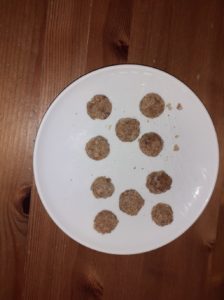
Here are a few pictures. Show your child one picture at a time. Ask them to estimate how many objects they can see. Don’t give enough time for your child to count! You could estimate too, and make it into a game with your child.

I usually start by making a really daft estimation – for example “Are there a million?”  or “Is there 1?” This makes the children laugh, but also emphasises that they are not sensible guesses, which is what an estimate is.

Show your child this picture quickly. Don’t let them count! Ask them to estimate how many building blocks they think there are. You could ask them to write down their estimation. Look at the picture again and allow your child to count the blocks. Was their estimate close? Did they estimate more or less than how many there are?

Repeat by asking your child to estimate and write down how many ducklings they can see here.

Ask your child to count the ducklings and then write the actual amount. Ask the questions “Did you estimate more/less than there actually are?” “Was your estimate close/sensible?”

Repeat the activity with the following pictures.


You could extend this activity by playing the following game and using objects you have in your house. Dry pasta, small blocks, counters from games, raisins. grapes, smarties, dry cereal or anything small enough for your child to ‘grab a handful’ can be used. You will also need a plate or dish, paper and pencils.

  1. Ask your child to grab some of the objects and put them on the plate.
  2. Both estimate how many objects you think there are.
  3. Both write down your estimates
  4. Count to check. Who was closest? You could keep score of who has the nearest estimates
  5. Repeat activity a number of times – perhaps take it in turns to grab the objects.


Holy Trinity EYFS and KS1 Story Time

We all love stories in Early Years and KS1. Here are some links to some familiar faces sharing stories. We hope your children will appreciate them. There will be more to come…

https://youtu.be/CElRd4zmAd4 

https://youtu.be/3-9f35T-lLw 

https://youtu.be/v0e98ODbfmQ 

https://youtu.be/Ds_RBxwz524 

https://youtu.be/5By7Ztgh3VU 


Some more ideas….

God’s Choir Song

Here is a link to a lovely song. Listen to it a few times with your child so they become familiar with it. Ask them to draw or paint some of the animals featured in the song. You will be humming the chorus for days!


Coin Rub Art

Following on from the maths activity today, you might like to do some coin art with your child. Place a piece of paper of a coin, carefully hold the paper and coin still and rub over it using a crayon or pencil. It maybe easier to use a small piece of blue tack or similar to hold the coins in place if you have any.

Monday Maths Work


Play shops with your child. Select some items from around the house. These could be toys to play toy shops or food items from the kitchen to play food shopping. Arrange the items and if possible ask your child to write some price tags on pieces of paper. These do not have to be realistic prices, but it is a good opportunity to encourage them to practise number formation.

Use any coins that you have in the house. Encourage your child to select and pay for items using the correct number of coins. If an item costs 3p, ask your child to pay with any 3 coins. The important thing is to talk about counting out the correct number of coins and using the language of money. Question such as ‘How much does it cost?” “How many coins?” “Will there be any change?” (Some may begin to understand the numbers on the coins and the amount of money they represent. If you want to talk about this with your child, please do. It will be easier to begin with pennies and paying with the correct number of pennies. Then explain that 2p is the same as 2 pennies, 5p is the same as 5 pennies etc.) 

Take it in turns to be the shop keeper and the customer. In Reception Class, children need to become familiar with and use language associated with money. You could show them a variety of coins, notes and credit/debit cards and discuss how these are all different way of paying for things. On Friday I posted a picture of a coin sorting activity. If your child has not completed this activity, it would follow on from nicely from today’s maths work.

Playing shops is also a good opportunity for your child to practise their subtraction. So if you started with 3 tins of beans in your shop and then your child buys 1 tin ask them how many tins would be left? Consolidate this by saying ‘3 take away 1 equals 2’ .

Here is a coin sheet to reinforce this work. Ask your child to colour in the coins accurately. Match any real coins to the pictures.

Coin Sheet

Here is a link to an interactive money game.

https://www.topmarks.co.uk/money/toy-shop-money 

Monday Literacy Work

Use this photo to encourage your child to write some sentences. Ask them to start with ‘I can see…..’

The more confident your child is with writing, the more you can ask them to write about the picture. Ask them to add details, such as what colour the dog is and what the dog is wearing. Some children can write three or four sentences. Remind them about their phonics. The children know the ‘oo’ sound they will need to write the word ‘book’. Please remind the children to use finger spaces. Remind them to use a full stop at the end of a sentence. Some may remember to use an exclamation mark if they think the sentence is funny.

Please read a story to your child today. Any story that you have at home that your child will enjoy is fine. It does not have to be a school book. When sharing this book ask the children to help you read some of the words.

Practice the ‘red tricky words’ I have provided you with. Read the phase 2 and 3 ones with your child. If they are confident with these, slowly introduce the phase 4. Encourage the children to write a few of them.

CHEEKY CHALLENGE!!!! Play teachers with your child. Ask them to test your reading of the tricky words. Then you can be the teacher and ask them to read and spell some of the tricky words.

Bug Club Online Reading

I am pleased to confirm that the full range of Bug Club books are available online for your child to access. Every pupil in Early Years and Key Stage One should have their username and password on the inside cover of their reading diary. If anyone is having problems logging in or cannot find their password, please contact the class teacher on the class email address. As well as a great variety of books there are fun comprehension activities to complete and the class teacher can see the progress being made.

A few more ideas….

Here are a few more ideas to engage your children!

This photo shows the lines and numbers drawn with a whiteboard pen on a mirror. However the activity can easily be done using paper and pens. If you have a safe outside space you could chalk the lines and numbers onto the ground. Any small items can be counted out. If working outside (in your own garden, away from other people) the children could count out leaves or stones.


The children love to use cotton buds and paint to trace over letters and numbers. You could also practise their names (first name and surname) using this method. If you don’t mind getting messy, they could use finger tips to paint instead of cotton buds! If you do not have paint, children could use felt pens or cotton buds dipped in water.

If you have some coins you could ask the children to sort them into different groups. You could talk about the numbers on each coin. Discuss the shapes, sizes and colours of the coins too. Please remind your child to wash their hands after handling money.

This activity would be best if you have your own garden. You will know that only your family has touched the leaves. Leaves can be threaded onto string or wool. You could collect small sticks and thread the leaves onto these. Cotton buds or drinking straws could also be used. Challenge your child to thread a certain number of leaves!

Again an activity safest done within your own garden of you have one. If you don’t have chalks, sometimes stones will leave a similar mark on the ground.

Please encourage your child to wash their hands thoroughly after completing activities. They have been shown how to do this in class and taught a song to help them. If you do go outside, please use your own space and stay away from other people. This is the safest option for your family and other members of the community.

Friday Maths

Halving

Please share this story with your child and let them look at the pictures. At the end of the story is an activity I’d like them to do.

Here are Ted and Pup. They are usually best friends.
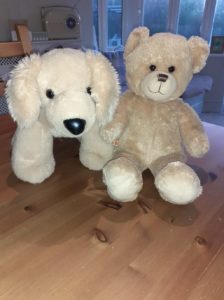
They haven’t been very good friends recently. They keep arguing with each other. They are not very good at sharing. Earlier they had bananas to eat. This is what happened.
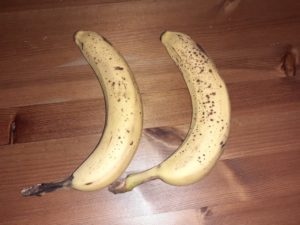
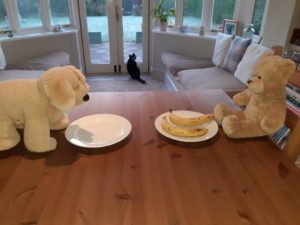
There were 2 bananas. Ted put them both on his plate. Pup had no bananas. Is this fair? What should they do? I had to tell them about sharing. They needed to have half each. This means they both have the same.
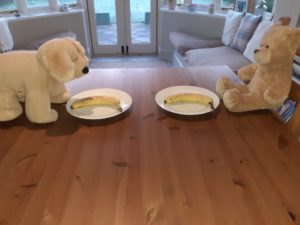
They shared the bananas. They both had half. Ted had 1 banana and Pup had 1 banana. Half of 2 is 1.

Then they had apples. This is what happened.
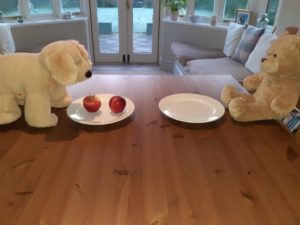
Now Pup had 2 apples. Ted had none. Ted had zero apples. Is this fair? What should they do? I reminded them to share. They needed to have half of the apples each. Half of 2 is 1. They worked together to share the apples.
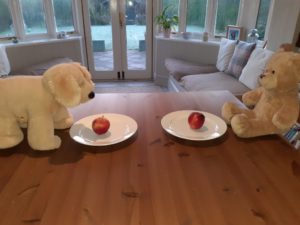
They were still hungry so they decided to have some oranges. How can they share 4 oranges so that they have half each? They both need the same number of oranges on their plate.
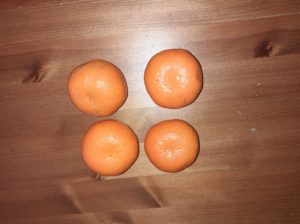
If Ted has 4 oranges and Pup has 0, is that fair? If Pup has 3 oranges and Ted has 1, is that half each? No! They worked together to share the oranges and had half each.
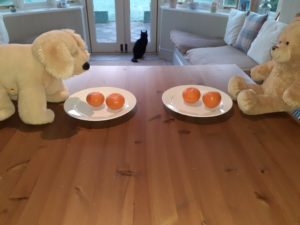
Pup had 2 oranges and Ted had 2 oranges. Half of 4 is 2.

They decided the best thing to do was to share everything fairly so that they always have half each. They put strawberries on a plate. How many strawberries are there?
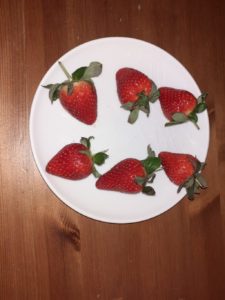
They put the plate between them and then shared them so they had half each.
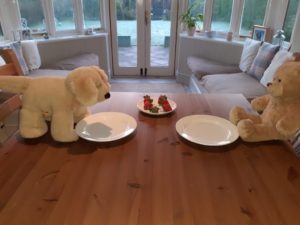
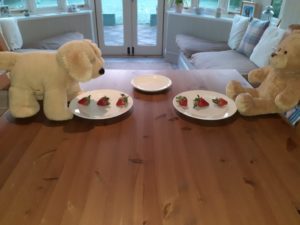
    

There were 6 strawberries. They shared them so they had 3 each. That was fair. They both had the same number of strawberries. Half of 6 is 3.

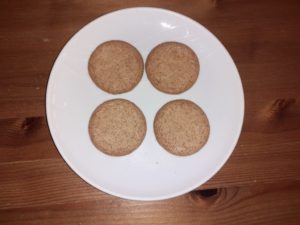
All day they worked together to share their food. They shared biscuits, tomatoes and breakfast cereal. They always made sure they shared fairly and had half each. Half means exactly the same on both plates.
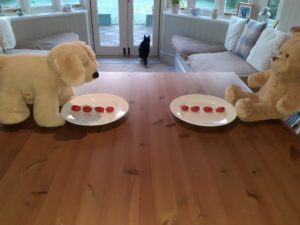
Now that Ted and Pup know how to share their food so they have half each they have stopped arguing and are much happier!

Activity

Ask your child to collect two soft toys and two plates. Collect a number of different foods or toys that your child can share between the two plates. Start by giving your child two items that are the same (2 bananas, apples, toy cars etc) Ask them to share the items so there are half on each plate. Remind them half means that there is the same on both plates. Repeat with two items, then increase to sharing 4 items, 6, 8 and then 10 items. Keep reinforcing the fact that both plates need the same number of items on them. Once the items have been shared correctly reinforce by saying ‘half of 2 is 1’ or ‘half of 6 is 3’

If you want to extend this activity you could use the frame from yesterday.
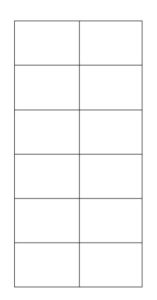
Write the number of objects given to your child on the sheet. They share the objects and then they write what half is onto the frame. The completed frame will look like this.
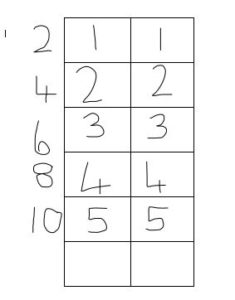
This is an activity the children can continue independently throughout the day. It is also something you could use with them at meal times or when they are playing with siblings. If your child has got playdough they could make cakes to share between the toys. They could make a playdough birthday cake for each toy and share candles between the cakes so they have half each. The important point they need to learn is that if they are sharing items so each person/toy has half, both must have the same. Some children may make the link between halving and doubling. For example they might spot by looking at the completed sheet that half of 10 is 5, and that double 5 is 10. If they notice this reinforce it throughout the activity.