Friday Literacy

If you accessed the additional ideas  for art and science yesterday, you may have watched the video about Owl Babies and talked about day and night. Today’s literacy story is also set at night time. It is written by Jill Murphy and is called ‘Peace at Last’

Poor Mr Bear had a very noisy night. Discuss with your child some of the noises that kept him awake. Ask your child to wrote down some of these noises. They can choose to write them in sentences, for example ‘The clock kept Mr Bear awake.’ or they can write them as a list.

Thursday – Art and Science (Owl Babies Animation)

Create some art work showing the difference bewteen day and night. Here are some ideas to inspire you.


Day And Night Craft For Kids - Sun And Moon Printable  


Watch this lovely animation of the story ‘Owl Babies’.

https://vimeo.com/55971653

Talk about the fact that the owls are awake at night time. This is because they are nocturnal. Nocturnal animals are awake at night time. They sleep in the day time. Can your child think of any other nocturnal animals. (For example, hedgehogs, foxes, bats, cats, badgers).


Thursday Maths and Literacy.

Today I’d like you to work with your child to sequence things that they do throughout the day. This covers the Reception Maths requirement to ‘Use everyday language to talk about time’.

Talk about these pictures first. What is happening in each one? They are showing a typical routine your child may have had before lockdown. Which does your child do first in the morning? Then what? Continue discussing both the pictures and your child’s routine right through until bedtime.

Help your child to write a simple sentence about each picture, on separate pieces of paper.

If you have developed your own new ‘lockdown’ routine you can use this. Please discuss this and help your child write it out in simple sentences on seperate pieces of paper.

Ask your child to read and sequence the sentences. It should look similar to this.


Amazing Home Learning!

Here are some more examples of brilliant home learning. Thanks so much for keeping in touch and sharing the wonderful things you have been up to. We have had a role play bus ride, followed by a real picnic in the garden, magic potions have been designed and made, objects have been measured, fantastic writing has been done, and some amazing scores have been achieved on Phonics Play! Well done Clee Class, I am so, so proud of you all.


Home Learning – Art Lesson Desert Doodles

In today’s lesson we are inspired by an artist who loves to doodle on everything, Sam Cox.

Cass Art Interview | Sam Cox (The Doodle Man) - Pick up a pen and ...

You don’t have to copy the drawings exactly, for this lesson if you want to change the desert images or the colours that’s fine, it is your art!

The Kooky Drawings of Sam Cox | Scene360

If you don’t have the same resources as the artist at home don’t worry, just use what you have. You could even try and make your own for this lesson.

The Doodle Man: Artist interview with Sam Cox | Cass Art

I hope you have fun drawing or painting along.

Wednesday – ICT

I have set three activities for you to do using Purple Mash. Follow this link, log in using the username and passwords you have, and access the ‘to do’s’ section. You can then save the work in your child’s folder and I will be able to see what they have done. https://www.purplemash.com/?utm_campaign=11544511_Purple%20Mash%20-%20Week%209%20-%20Weekly%20Activities&utm_medium=dotdigital&utm_source=2Simple%20Software&utm_Link_Name=Weekly%20Activities&dm_i=R2J,6VFSV,T7GZVS,RL462,1#todos 

Wednesday Literacy

Today I’d like your child to read a bug club book to you. Follow this link to login.

https://www.activelearnprimary.co.uk/login?e=-1&c=0

All details needed are on the inside of your child’s blue reading diary. A reminder that the password has been changed to 12345. All other details are the same.

Recap reading the tricky words with your child using your flash cards.

Look at this picture and discuss it with your child. Ask your child to write as many sentences as they can about it. Remind them to use capital letters, finger spaces and full stops. Ask them to sound out the words carefully and rremeber to use their tricky words.


Wednesday Maths

Today you are going to work on adding by counting on. Look at these slides, talk about them with your child. You can use the number line on the slide, or it may be easier to use a paper number line.

Use this slide to talk about list writing. Discuss how the words are listed one on top of the other instead of in a sentence. Recap on ordinal numbers by asking your child what is at the top of the list, and so what will we buy at the shop first? What will we by second, third etc? What is the last item on the list?

The first thing to buy is crayons. Can they find a number on the box to tell them how many are inside? There are 8. Can they find this on the number line? They are also buying 2 more crayons. Ask them to start at 8 and do two finger jumps to show they are buying 8 + 2 crayons. What number do they land on? Reinforce this verbally by saying 8 + 2 = 10.


How many apples are in the basket? Find this on the number line. How many more apples are you going to buy? Finger jump two numbers. What number do you land on? So how many apples have you bought in total? 5 + 2 = 7.
Repeat this process with the next few slides.

Here are two printable worksheets to support what you have been working on today. One uses numbers to 10, the other numbers to 20. I have also added photos of the worksheets so you can copy them out if you are not able to print them off.

addition by counting on to 10

addition by counting on to 20


Tuesday Additional Ideas and Science

Make Bus Tickets and play Buses

Your child watched a video about going on a bus in Literacy. Perhaps they could make bus tickets for each member of the family?  Or perhaps for their soft toys? They could role play going on a bus with their toys by siting them one behind the other. Your child could be the bus driver, giving each toy their ticket. They could use a plate or saucepan lid as the steering wheel!

Exercise!

Talk to your child about their breathing. Is it fast or slow?

Ask them to place their hand on their heart (on their chest). Can they feel it beating – slow and steady. Emphasise that both their breathing and their heart rate are slow and steady. Explain that it is because their bodies have not been moving quickly. Their bodies have been moving in a slow and steady way and so their breathing and heart rate are slow and steady.

Choose some lively music to dance too. Encourage your child to move quickly, the aim is to increase their breathing and heart rate!

When your child is slightly out of breath, ask them to stop and think about their breathing now. How has it changed? Can they feel their heart beating in their chest? How has that changed? Explain that their heart is beating faster now to pump their blood around their body. Their breathing is faster because they have been exercising and they need to get more air (oxygen) into their bodies.

In Reception, the aim is for your child to observe and notice the changes of exercise on their bodies. A simple coversation about the changes will support this. They will learn more about the science behind these changes as they progress through school.

Tuesday Maths

Warm up by singing this song and joining in with the actions!

Start by laying your number cards face up on the floor. Ask your child to ‘move like a bus to number 15’, ‘like a train to 9’, ‘like a plane to 14’ and so on. If you feel your child is still uncertain with certain numbers, keep asking them to move to that number so they become more familiar. If you feel your child is confident with these numbers, make your own number cards from paper and select a few numbers (ten or so) up to 30, 50 or even 100.

You will need one or two bus templates again today depending on the ability of your child. Two buses will allow your child to work with larger numbers. You will need some small toys, figures or counters. Your child will be writing out addition calculations so they will need paper and pencils to do this.
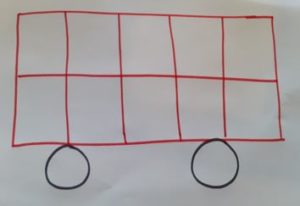
You will also need your number cards again. Lay them face down.

Ask your child to turn over a number card, put that many people on the bottom layer of the bus. If it is a large number because your child is more confident with numbers they may almost fill up the spaces on the bus.

Ask your child to write down this first number followed by the ‘+’ symbol. (for example if they turned over a 5 card and then put 5 counters on the bus they would write 5 + onto their paper)

They then turn over another number card. What number is it? Ask your child to add this amount of toys, figures or counters to the top layer of the bus (or the second bus template if needed).

Ask them to write down the second number.  (so if it was a 4 number card this time, they would add 4 counters onto the bus and continue writing out their calculation so it now looks like this 5 + 4 )

Ask your child to count the total number of toys, figures or counters and then write the answer on their calculation. (It now looks like this 5 + 4 = 9)

Repeat this activity a number of times until your child is confident to work independently or with minimal support.