Additional Ideas – Maths Scavenger Hunt

Challenge your child to use their Maths and go on a scavenger hunt!


Thursday Maths

Today I’d like you to introduce the concept of symmetry to your child. It is quite a tricky concept, but something that is fun for them to do. Explain to your child that symmetry means something looks the same on both sides of the line. Show your child these pictures to explain.

Today I’d like you to make some symmetrical balloons. There are two methods. You will need some paper cut into balloon shapes.

For the first method, you will need the paper balloon shapes and some paint. Fold the balloon in half lengthways.

Unfold the balloon. Ask your child to create a simple pattern on one half of the balloon.

Fold the balloon in half again and gently press down. Carefully open up the balloon again. There should now be a symmetrical pattern on both sides of your balloon.


Talk to your child about how the pattern looks the same on both sides of the folded line.

For the second method, you will again need paper balloon shapes. You will need coloured pens or pencils. Draw a line down the length of the balloon. Explain to your child that one half of the balloon is yours and the other half is theirs. Draw a very simple pattern on your side of the balloon.


Ask your child to copy the pattern so their side of the balloon looks exactly like your side.


This is very tricky and the symmetrical pattern is unlikely to be perfect. However it is a good starting point. Perhaps from here you could look at butterflies and ladybirds and discuss how they are symmetrical. Challenge your child to find other symmetrical items or pictures.


Thursday Literacy

Start by watching this clip about hot air balloons.

Has your child ever seen a hot air balloon?

Look at these pictures and talk about them with your child. What do the balloons look like? What words can they think of to describe the balloons? Where are the balloons flying over? How do they know? Can they see anything interesting near or under the balloons?

Ask your child to think of and write some simple sentences to write about the pictures. Remind your child to use a capital letter at the start of the sentences. They need to use finger spaces, use their phonics to sound out the words carefully, try to use tricky words and use a full stop at the end of their sentences.

Please log on and ask your child to read a bug club reading book today. ttps://www.activelearnprimary.co.uk/login?e=-1&c=0

Wednesday Literacy

Watch the ‘Great Balloon Hullaballoo” again.

In the story Simon the squirrel visits different planets to buy different things. Today I’d like your child to imagine they are visiting planets to do their shopping. Their writing task is to make a shopping list.

Here are the planets I’d like your child to imagine they are visiting.

I’d like the shopping list to be funny and imaginative. The only rule I have is that what they buy from each planet has to start with the same letter as the planets name. Have fun with this activity. Here is an example shopping list:


Here is a link to a phonics game called ‘Picnic on Pluto’ that your child will enjoy playing.

https://www.phonicsplay.co.uk/PicnicOnPluto.html#

Additional Ideas – RE and Blowing Bubbles

Here is a lovely animated story from the Bible. It reminds us not to worry, God is looking after us. Ask your child to think about what they are grateful for. Can they draw pictures to show what they are grateful for?

Blow Bubbles

If you don’t have access to a shop bought bubble pot, you can make your own bubble mixture using this recipe.

Bubble mixture
Makes 350ml
Prep 5 minutes
50ml washing-up liquid (one part)
300ml water (six parts)

1. Measure the washing-up liquid into a container, such as a jam jar or glass bottle.
2. Slowly add in the water, being careful not to create too many bubbles at this stage. Gently stir the mixture together to combine – a chopstick is perfect for this.
3. If you can, let the bubble mixture rest before using it, as it will make your bubbles even better.
4. When you’re ready, dip your bubble wand into the mixture and start blowing bubbles!
Homemade bubble wands
If you don’t have a wand from a store-bought pot of bubbles, don’t despair! You can have fun by looking for different items around the house that can be used to make bubbles. Here are some ideas to get you started:

Paperclips – bend them into wands or use as they are
Straws
Biscuit cutters
Pipe cleaners
Fly swatters

Top tips
Glycerine can be found in the baking section of most major supermarkets and can be added to the bubble mixture to make it more stable. We found that adding 1 tbsp glycerine to the recipe above made our bubbles last much longer.
Letting it rest overnight, or as long as you can bear to wait, does allow the mixture to settle and combine, which will improve your bubbles.
Think big – if you want to scale up the recipe, you just need one part washing-up liquid to six parts water. Try making a big bubble mixture in a washing-up bowl – then you can use bigger items, like colanders and slotted spoons, to make bubbles in the garden.

Wednesday Maths

Please start by playing a throwing and catching game. If you have a balloon use this, otherwise a ball or even balled up socks will do. Stand about a meter apart and count how many throws and catches you can do before the balloon/ball is dropped. Repeat the activity a few times. Increase the challenge by stepping further apart or by trying to beat your total each time.

For today’s activity you will need a piece of paper with a hot air balloon drawn onto it. You will also need some small toy people/animals/counters/coins or similar. You will also need number cards 1-10. Your child will need a piece of paper and a pencil.

Remind your children about subtraction/taking away. Write down the symbol (-) to remind them what it looks like and what it means.

On a sheet of paper, draw a hot air balloon, it might look similar to this.
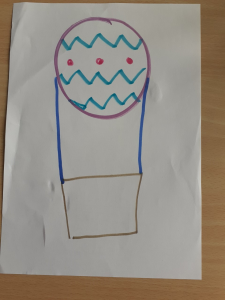
Separate the number cards into 2 piles (1-4) and (5-10)

Ask your child to choose a card from the higher numbers pile. Put that many people/counters into the hot air balloon. In this example the number card 7 was chosen, so 7 people/counters were put into the balloon.
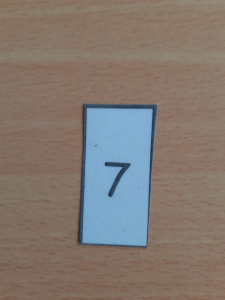
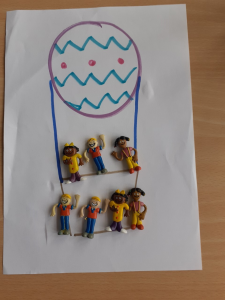
 

Ask your child to write that number on their paper.
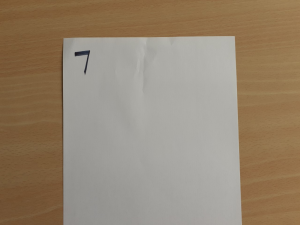
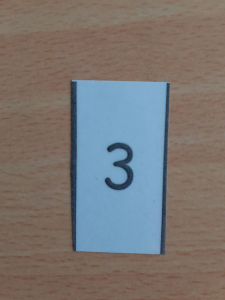
Then ask them to choose a card from the lower numbers pile. In this case the number 3 was chosen. Ask them to take this number of people/counters out of the balloon.
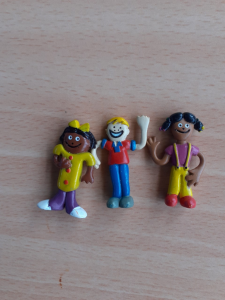


Emphasise that they are taking these people away. Write out this part of the calculation.
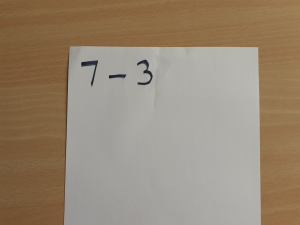
Ask your child to count how many people are left in the balloon, and write the answer to the subtraction.
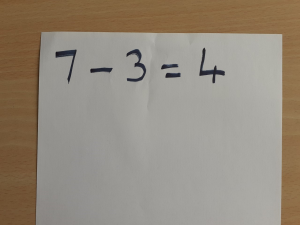


Verbally emphasise the calculation. Using the example given I would say ” 7 take away 3 equals 4″


Repeat this activity a number of times until your child can work and write out the calculations independently or with minimal support.




Tuesday Additional Ideas – Art and Craft

Make a Papier Mache Hot Air Balloon

You will need:

  • A blown up balloon
  • Newspaper/paper/magazine paper ripped up into pieces
  • Glue (PVA/ child safe wall paper paste/ flour and water mixed)
  • A basket (margarine/yoghurt tub or a plant pot would work well)
  • String or wool
  • Tape
  1. Soak pieces of paper in the glue and add them in layers over the balloon until it is covered. When a layer dries add another layer. Ideally you want 3 or 4 layers of paper covering the balloon.

2) When the papier mache is dry, it should feel hard. Pop the balloon and discard it.

3) Decorate the balloon using paint/pens/stickers or whatever you have.

4) Attach string or wool to the balloon and add the basket

Tuesday Literacy

Watch this story called ‘The Great Balloon Hullabaloo’


Can your child identify any rhyming words in the text? Write out a selection of the rhyming pairs. Don’t worry about the correct spellings – encourage your child to sound out the words and spell them as they think.

ball/hall

money/honey

cheese/please

moon/balloon

try/sky

frown/down

stars/Mars

bread/head

moss/cross

Saturn/pattern

said/head

mist/list

face/place

back/snack

power/shower

pop/stop

Chat to your child about where they would go if they had a hot air balloon.

Use the tricky word cards. Allow your child to be the teacher. Ask your child to read a word and you have to write it. Get some right, but get some wrong – does your child notice?

Swap roles, you read some tricky words and your child writes them.


Tuesday Maths

Today you will need your 1 -20 (or 1-30) number cards.

Start by showing your child a card and asking them to do that many star jumps/hops/hand claps etc. Repeat a few times.

Ask your child to arrange the cards in order. Perhaps challenge them to try and beat a timer on your phone.

Play the game where you point to a number and your child says what number it is. Move your finger up and down the number line quickly – see if you can catch your child out!

Ask your child to close their eyes. Turn a number card over and place it face down so the number cannot be seen. Ask your child to tell you what number you have turned over. Ask them to explain how they know. You are trying to encourage your child to use language such as “because it is one more than…”  or “because its the next number” or “because it comes in between those numbers” Repeat a few times. Swap roles so that your child turns a card over. You could try guessing the number wrong, how does your child know you are wrong?

Monday Maths

Start by joining in with this song.

Today I’d like you to play an adding game with your child. Draw two grids like this and number them 1 – 12. You will also need two dice or two sets of 1-6 number cards, and two coloured pencils or pens.

You and your child will each have a number grid. Ask your child to roll the dice or turn over two cards and add the numbers together. They find this number square on the grid and colour it in. Now it is your turn to roll the dice, or turn over the cards. Find  and colour in the total. Continue taking in turns with your child. The winner is the person who colours in all their squares first.